
Military Presence Intensifies in Regla, Havana
In the government’s hope that fear can quiet protests
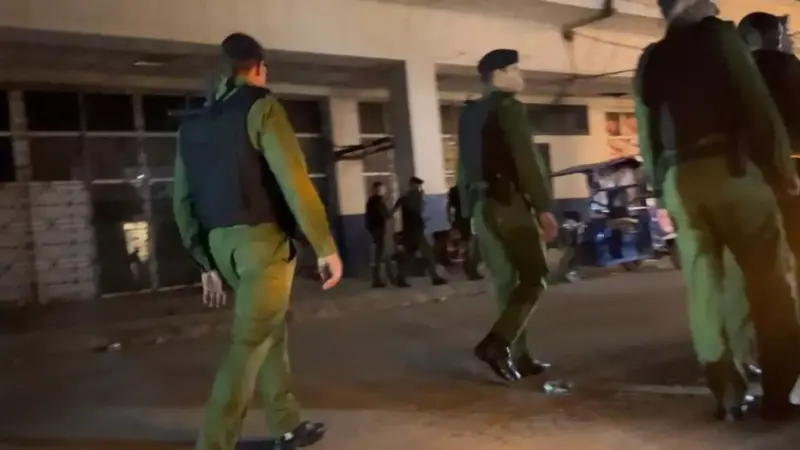
As the fifth anniversary of the massive July 11, 2021 protests approaches, an increase in police patrols is noticeable in several municipalities across the country.
HAVANA TIMES — The weekend brought no relief to the Havana municipality of Regla. Hours of heat, water shortages, and power outages continued to accumulate, perhaps worsened by a transformer failure on Sunday. Or perhaps not, since the day before, pots and pans once again rang out in the neighborhood in broad daylight after residents endured 30 consecutive hours without electricity.
The protests are under close scrutiny. Authorities are trying at all costs to prevent another July 11, 2021, uprising, whose fifth anniversary is drawing near. This explains the reinforced military and police presence in the capital.
“The agents were patrolling up and down the busiest areas, especially in front of the People’s Power offices. You could see them on every corner. They walked past the cafés and bars on 24 de Febrero Street and just stared at you. They’ve been like that for about three days now,” a local resident told 14ymedio, noting the unusual abundance of olive-green uniforms. These images were taken by the newspaper on the night between Saturday and Sunday but could not be sent to the newsroom until the following day because the lack of electricity has kept communications at a minimum for many weeks.
Protests in Regla have been recurring over the past several days. On Thursday, about thirty residents demonstrated in front of the Communist Party headquarters, and a day later they overturned garbage containers and set them on fire.
The regime’s fear of a social explosion is visible. Conditions for unrest are at their peak, and the police presence is multiplying as a constant reminder of what can happen to anyone who takes to the streets. What occurred this Sunday in El Vedado is another example. At least four police patrol cars and several police motorcycles gathered along the Malecon seawall, where a small group of young people had gone swimming. Images taken from the Giron building quickly went viral, and while some people welcomed the removal of swimmers from a dangerous area where swimming is prohibited, criticism of the police response intensified.
“Once again, the police are functioning as a repressive force against young people who have no water, no electricity, and probably no food in their homes. They weren’t hurting anyone; they were simply swimming by the Malecón. There’s fuel apparently for this police repression. The people against the people,” said one witness, who reported that at least one person was detained during the incident.
“If they saved all the fuel that’s spent every day on police deployments, we wouldn’t have so many electricity problems,” one social media user commented. “And yes, these deployments are happening all across Cuba, not just in Havana.”
The observation was not unfounded. On Friday, Miguel Diaz-Canel visited the area in his capacity as president of the National Defense Council. “The Defense Zone must be represented by the Communiste Party and Government of each community, both in peacetime and in wartime. Cuba’s complex current situation demands it,” said the leader, referring to the high population density of the Carmelo neighborhood in El Vedado.
Díaz-Canel spoke about the need for periodic military exercises, while emphasizing defense plans, including care for vulnerable populations and “ensuring that citizens are familiar with shelter locations to guarantee a smooth evacuation.” Jorge Luis Aneiros Alonso, president of that defense zone. He stated that it is important for citizens to know “where they can go in the event of aggression against the country to receive better protection. The first step is identifying and verifying the safe locations we have in the area… taking advantage above all of basements, semi-basements, and certain tunnels.”
The sight of uniformed personnel, however, does little to reassure a population focused mainly on carrying out the most basic tasks of survival—eating, drinking, and sleeping—amid continuous blackouts. On Sunday, the national electric utility devoted its social media accounts to honoring the late Commander Ramiro Valdes through numerous tributes, including one praising him for leading “the government program, together with the country’s highest authorities, for the recovery of the National Electric System and actions related to the energy transition.”
“May he rest in peace, but I want to talk about something else,” users responded, exhausted by the endless hours without power and the lack of answers from the utility company.
In the early hours of Monday, the Antonio Guiteras thermoelectric plant in Matanzas, Cuba’s largest power station, began restarting after its latest breakdown, which had removed it from the national grid for the fifteenth time already this year. But even that no longer inspires hope.
With or without the plant, a power deficit of roughly two-thirds of demand has become almost permanent on the island, and the regime is mobilizing its apparatus of control to prevent another mass protest like the one five years ago—one that could again trigger repression and, ultimately, a possible response from the United States.
First published in Spanish by 14ymedio and translated and posted in English by Havana Times.