
Support for Caregivers in Central America, a Distant Dream
HAVANA TIMES – Efforts to establish caregiving policies in Central America are moving slowly, hampered by structural shortcomings and the lack of a public network of services—such as care centers for children and the elderly—that would prevent the burden of care from falling mostly on women.
The consistently limited funding in the seven Central American nations prevents the expansion of these services, leaving the creation of a comprehensive care system a distant goal in the region, which includes Belize, Costa Rica, El Salvador, Guatemala, Honduras, Nicaragua, and Panama.
The isthmus is marked by deep socioeconomic divides, with high levels of inequality, informal employment, and fiscal constraints that limit the ability of governments to expand social protection systems for a combined population of 53 million.
Behind the structural gaps in care provision, everyday dynamics result in family arrangements where responsibility falls disproportionately on one person, usually a woman close to the vulnerable family member—in the case of older adults.
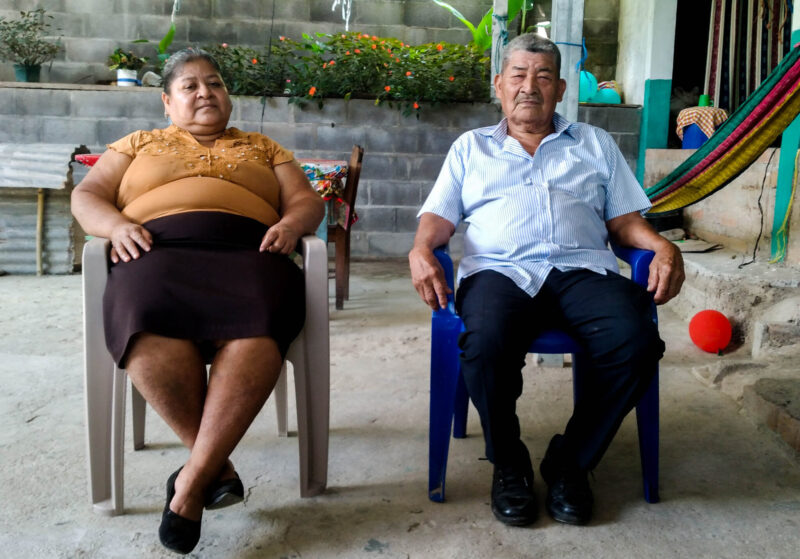
“We’re always looking out for my dad here; he’s a strong man, thank God,” Ana Alvarado, 51, told IPS. She is responsible for caring for her father, Manuel de Jesus Alvarado, 85. Ana and her father live in the canton of El Transito, a rural settlement in the district of Santa María Ostuma, in central El Salvador.
Ana explained that she used to work in San Salvador, the country’s capital, a little over 43 miles away. But five years ago, she began providing permanent care for her father after a series of serious medical complications, including multiple surgeries and an infection that left lasting effects on his health.
“He almost died on us,” she said.
Her father, sitting beside her, nodded and remarked, “You don’t always have the same energy you had when you were young; you can feel your advancing years and the blows of illness.”
“It fell to me to come here, because I was the only one who wasn’t married. I had to be here. My siblings, even if they wanted to be here, can’t—they work in San Salvador and already have their own homes,” Ana said, her tone somewhere between understanding and resignation.
The Burden on Women
Care is understood as the set of activities necessary to sustain the daily life and well-being of a person or people. It ranges from caring for children, the elderly, the sick, and dependent individuals to the domestic work associated with these tasks.
According to UN Women, this work is essential to the functioning of society and the economy. It encompasses both unpaid care within households and paid caregiving services, but in both cases tends to fall disproportionately on women.
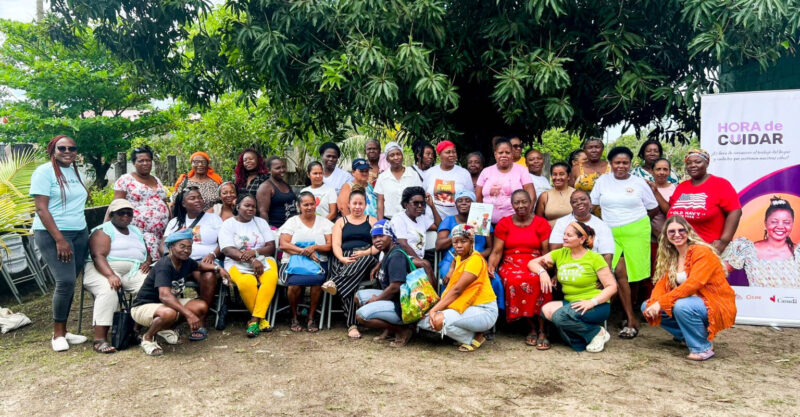
The women of Central America’s northern triangle continue assuming the greater part of the unpaid caregiving according to the report: State of the situation of the caregiving sector in Guatemala, El Salvador and Honduras, published in October 2025.
The report notes that similar patterns in the organization of care persist in all three countries, which widen gender gaps.
In all three countries, women devote between three and five times more time to domestic work and unpaid care work than men, which is reflected in lower female labor force participation.
Nearly 70% of Guatemalan women remain outside the formal labor market, as do 66.7% of Salvadoran women and 64.7% of Honduran women. Many end up taking on sub-standard jobs, characterized by low wages, a lack of social protection, and scarce training opportunities.
“In Guatemala, women continue to shoulder the bulk of unpaid care work, which prevents them from entering the labor market, continuing their education, or dedicating time to their own well-being,” Maritza Velasquez of the Association of Domestic and Maquila Workers and the Guatemalan Care Network told IPS. Velasquez served as the study’s coordinator.
The research also found that care provision in the region continues to rely primarily on informal family arrangements, due to the lack of coherent regulatory frameworks and sustainable financing mechanisms—a model that perpetuates gender inequalities throughout women’s life cycles.
“We have seen that women definitely devote more of their lives to caring for others than to caring for their own selves,” Maritza Velasquez asserted.
In the face of this panorama, the study proposes allocating at least the equivalent of 1% of gross domestic product (GDP) to a multi-year care fund to expand social infrastructure and reduce the shortage of services for early childhood, older adults, and people with disabilities.
Few real advances
Progress on care policies in Central America shows varying levels of development among countries, with significant gaps in their institutionalization and scope.
While Guatemala, Honduras, and El Salvador are just beginning to build more systematic frameworks to organize care provision—still with fragmented initiatives and funding constraints—Costa Rica is at a more advanced stage.
In 2022, that country passed the National Care System Act, which provided the legal basis for implementation of a state-run network that coordinates public and private services for adults and people in situations of dependency, in order to protect them and support caregivers—whether paid or unpaid—to improve the quality of life for both parties.
In El Salvador, a framework for care policy exists, but its scope in practice remains very limited.
“It is a little-known instrument with very limited possibilities of becoming operative, since it lacks a budget,” Carmen Urquilla told IPS. Urquilla, a member of the Organization of Salvadoran Women for Peace, was referring to El Salvador’s National Policy on Shared Responsibility for Care, adopted in 2023. This initiative is not a law passed by the Legislative Assembly, but rather a public policy instrument of the Executive Branch.
This means it doesn’t have binding legal status but rather serves as a guiding framework for institutional actions and programs. Its implementation depends, in practice, on political will and the allocation of budgetary resources.
The Salvadoran expert explained that one of the main challenges lies not in defining the problem, but in the lack of resources to translate it into concrete services such as childcare centers or centers for supporting older adults.
She also noted that the current approach tends to focus more on those receiving care than on the organization of the system that supports them.
In Guatemala, the discussion on care remains in its early stages, with only intermittent advances. “Progress is still in its infancy,” affirmed Velasquez, noting that there is still no consolidated public policy.
The leader recalled that some institutional initiatives on care were promoted by the Presidential Secretariat for Women during the administration of Alejandro Giammattei (2020–2024), but she cautioned that these processes have lost momentum with the transition to the current administration of Bernardo Arévalo.
She added that the transition between the two administrations has led to the interruption or slowdown of several previous initiatives, which has affected the ability to ensure their sustained follow-up within the state apparatus.
As she explained, this instability has hindered the development of a sustainable system that includes the formal participation of social organizations.
Velásquez added that, although talks have recently resumed, the process still lacks a clear roadmap and stable mechanisms for coordination between the state and civil society. In her view, the country is still in the early stages of defining what kind of care system it wants to build.
In Honduras, the debate has moved toward more structured proposals, although without legislative approval thus far.
“The country does not yet have an approved law, but it does have drafts and working groups,” Suyapa Martínez, director of the Center for Women’s Studies in Honduras, explained to IPS. An opposition congresswoman has presented the draft of a bill for a Comprehensive Care System Law, while the government is working on its own proposal, with the intention of merging them and moving toward a common framework.
However, she cautioned that progress on this agenda has been marked by political shifts and changes in priorities with the arrival of a new government. This has hindered the sustained continuity with previous efforts and the consolidation of a stable legal framework for the care system.
The ultra-conservative Nasry Asfura, backed by US President Donald Trump, took office as president of Honduras in January of this year, following Xiomara Castro’s four years in office (2022–2026).
Good laws, but far-off for the moment
The Honduran activist explained that the proposed comprehensive care system includes a combination of cash transfers and the expansion of public services, with the creation of vouchers for caregivers and direct support for households that perform these tasks.
This would be complemented by day centers for older adults, home care programs, and assistance for people with disabilities, as part of a support network aimed at reducing the current burden on families.
The implementation of this plan, Martínez noted, would require a significant investment, estimated at around $29 million over a four-year period, according to preliminary studies included in the proposal. One of the main models for the system’s design is the experience of Uruguay.
Since 2015, that country has had a National Integrated Care System, which recognizes care as a human right. That model, based on shared responsibility and shared funding among the government, families, the market, and the community, has broken new ground in Latin America.
In 2024, Panama partially followed the model by establishing a People’s Care System which “guarantees the right to care, full well-being and development of individuals, as well as protecting their autonomy,” providing legal support to people receiving care and to their caregivers. However, the system still faces challenges in its implementation.
In the case of Honduras, Martinez noted that the process still depends on political agreements and the allocation of sustained resources for its implementation.
Meanwhile, the Salvadoran caregiver, Ana Alvarado, recognized that she would have liked to continue working or develop her own project, but ended up completely reorganizing her life to care for her father.
She explained that she receives financial support from her siblings for her father’s medications and other expenses; they remain very involved, but the day-to-day care falls almost entirely on her.
“Maybe I would have liked to have my own things, to work toward having my own home and family, but this was what destiny held for me,” Ana affirmed.
First published in Spanish by IPS and translated and posted in English by Havana Times.