
The Kings of the Road: Electric Tricycles in Cuba
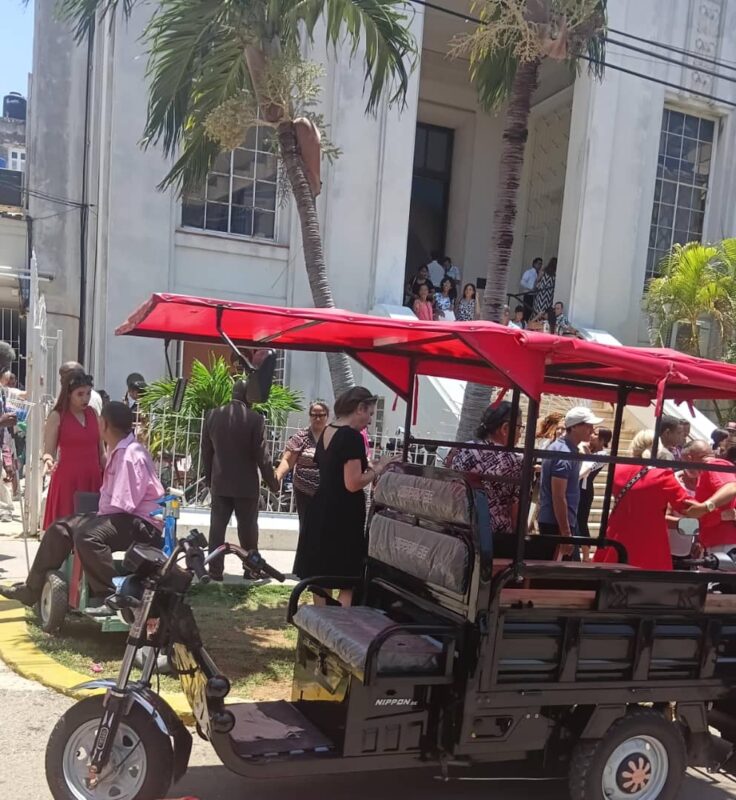
HAVANA TIMES – On the streets of Cuba, the roar of 1950s engines has been replaced by a metallic, electric hum, almost silent. The almendrones—those faded-chrome Cadillacs and Fords that for decades symbolized the city’s transportation—now sit parked along the sidewalks. Out of gasoline. Without owners who can afford the five dollars per liter it costs. In their place have arrived the new kings of the road: electric tricycles and pedicabs.
They first appeared months ago as a desperate solution. Now they are everywhere—in the streets of Matanzas, Camagüey, Ciego de Ávila, Guantánamo, across the entire island. They are three-wheeled vehicles powered by a small electric motor or simply by pedals. Some have canvas canopies to shield passengers from the sun. Others blast music from loudspeakers because, if you’re going to survive, you might as well do it with salsa. They charge between 200 and 500 pesos (roughly $0.40 to $1.00), depending on the distance, whereas a private taxi used to cost three times as much. Demand, the drivers say, is “through the roof.”
A driver can make as many as twenty trips a day if his legs hold up. But legs have their limits. So do batteries. Because these kings of the road wear a fragile crown: they depend on electricity. And in Cuba, electricity is a luxury that arrives only two or three hours a day. That is why many have installed solar panels on their roofs. Small, makeshift ones, but enough to recharge a battery while the relentless sun beats down. “We’re very resourceful,” one driver says as he secures a panel with duct tape. “Cubans have outsmarted the devil.”
They are not just drivers. They are mechanics, electricians, and inventors. Spare parts don’t exist, so they make their own from pieces of other machines. An old bicycle wheel, a cable from a broken washing machine, a recycled car battery—everything has a use. Informal repair shops have sprung up on street corners where tricycles are fixed with wire and patience. Owners take turns using the tools. No one has much, but everyone has something to share.
Aware of the phenomenon, the government has tried to regulate it. In February 2026, the Ministry of Transportation issued instructions for granting operating licenses to owners of electric vehicles. Temporary permits were also authorized for electric motorcycles and tricycles without license plates through December 2026. In practice, however, many continue to operate without documentation, enjoying the tacit approval of authorities who know that without them, the cities would come to a standstill.
For passengers, these vehicles are a lifeline. People use them to get to the doctor, to work, to take children to school, or to bring an elderly relative to a medical appointment. A woman waiting on a street corner with her mother in a wheelchair summed it up this way: “It isn’t much, but it’s the only thing that comes by.” It’s neither comfortable nor fast. But it’s what there is.
Others use them to earn a living. Food delivery workers, street vendors, and people transporting merchandise from one place to another all rely on them. A tricycle can carry up to one hundred kilos if you push it hard enough. As a result, the streets have also filled with small businesses on wheels: the bread seller, the soft drink distributor, the man hauling crates of eggs from one municipality to another. The tricycle is not just transportation. It is a livelihood.
The price of these vehicles, however, puts them beyond the reach of most. Handcrafted pedicabs currently sell for as much as 200,000 pesos (about $400). A fortune for the average Cuban, whose monthly salary is around $13. Yet many have made the sacrifice. They have sold what little they owned or borrowed money from relatives abroad. Because without a tricycle, there is no work. And without work, there is no food.
But it is not all smooth sailing. Drivers complain that authorities sometimes fine them or demand permits they do not have. Then there are the accidents. Brakes in poor condition, streets riddled with potholes, and almost nonexistent street lighting make the nights especially dangerous. One pothole, one sharp turn, one moment of inattention, and the tricycle overturns. Drivers learn to navigate with their eyes wide open.
Despite everything, they keep going. At dawn, when the sun has barely risen, they are already on the streets. At night, when the power goes out and the buses have not passed for hours, there is still someone offering one last ride. They are the kings of the road, yes—but of a road that is broken, dark, and full of obstacles. Still, they travel it with patience, ingenuity, three wheels, and a hope that refuses to die.
Read more from the diary of Safie M. Gonzalez here on Havana Times.
Where are they manufactured? Who’s bringing them in? Put solar panels on the tops? $400.00? I’ll invest in one.