
Cuba: Inspectors Raid Private Businesses to Seize Pesos
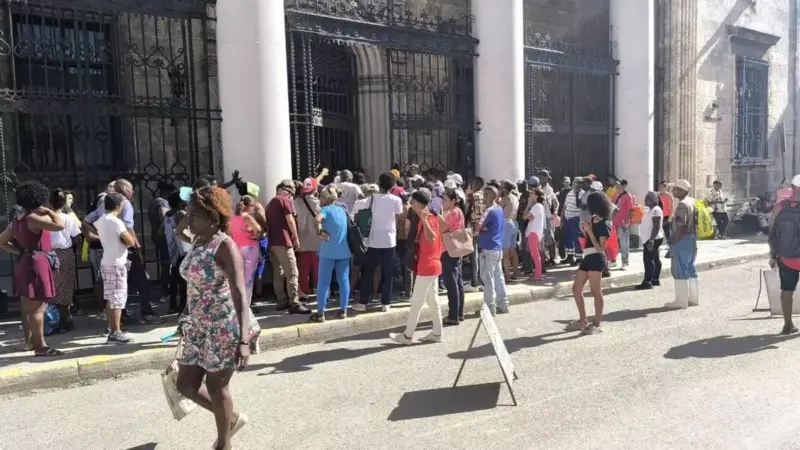
Banks have run out of money, and the authorities are carrying out these confiscations supposedly to pay pensions.
HAVANA TIMES – “Some inspectors came in and demanded that we hand over all the cash in the register,” a witness to one of these operations, which have taken place in several provinces across the country, told 14ymedio. He saw it happen in Holguín, but other sources report similar incidents at private businesses in Matanzas and Camagüey. “In exchange, they make a bank transfer to your account, but when you go to the bank to withdraw the money, you can’t get any cash,” he said. “They credit you with a transfer, but when you try to withdraw it, there’s no cash available.”
The authorities, who have publicly accused private businesses of hoarding cash, have begun forcibly removing the cash accumulated in the registers of private businesses and replacing it with bank transfers. Witnesses describe an almost identical procedure, carried out by inspectors, bank officials, and police officers, leaving businesses without the cash needed to make change, pay suppliers, or restock merchandise.
Another complaint posted on Facebook this Friday describes a similar situation in Matanzas and attributes the measure to the government’s inability to pay pensions. “The banks in Matanzas have run out of cash and have been unable to pay retirees,” the post begins. It was later shared across numerous profiles and groups.
The post claims that the Provincial Government, the Communist Party, executives from Banco de Crédito y Comercio and Banco Popular de Ahorro, together with police officers and inspectors, are “invading private businesses to seize all the cash on hand in their registers.”
“Without any prior notice, they shut the businesses down, enter them, count all the cash in the registers, and force the owners to hand it all over,” the complaint states. Afterward, it says, the officials “make a bank transfer to the business’s fiscal account for the exact amount of cash taken.”
The post maintains that businesses are left “without any cash to operate, not even enough to make change,” and blames the decision on the first secretary of the Communist Party in Matanzas and the provincial governor. It also claims that some business owners who resisted were threatened with fines, closure of their establishments, or even arrest.
The account from Matanzas matches a complaint made by Katia Castello Morgade, a self-employed entrepreneur in Camagüey, who said that Finance inspectors, accompanied by police officers and bank employees, were removing cash from private businesses after conducting cash register audits.
“During the inspection, they count the cash and immediately deposit or transfer it into the banking system, leaving the businesses without liquidity,” summarizes one of the videos posted on Instagram.
The entrepreneur clarified that the officials do not directly confiscate the money for themselves but instead force businesses to deposit it into the bank. The result, however, is the same: the business loses the cash it needs to operate and receives, in exchange, an electronic balance that is difficult to use in an economy where many suppliers accept only cash. This is compounded by the difficulties of making electronic payments, since power outages frequently prevent such transactions for many hours at a time.
For years, the Cuban authorities have sought to force the banking of commercial transactions. Resolution 111 of 2023, issued by the Central Bank, established limits on cash payments and collections, as well as rules governing the deposit, withdrawal, and possession of cash. The regulation requires businesses to deposit their daily earnings but does not explicitly authorize inspectors or police officers to remove all the cash found during an inspection without leaving even a basic cash reserve.
The problem has worsened because Cuba’s banking policy works in only one direction. The State requires businesses to deposit their cash, but the banks do not guarantee that it can later be withdrawn. The official press itself has reported for years on complaints about the lack of cash at ATMs and bank branches, restrictions on cash withdrawals, including wages, and the refusal of many businesses to accept bank transfers.
The reported police operations appear to respond to a more immediate need than fiscal discipline. Faced with a shortage of cash to pay pensions, salaries, and benefits, the government appears to be turning to the cash registers of private businesses and self-employed workers as a source of immediate liquidity.
So far, neither the Central Bank, the provincial governments mentioned, nor the Ministry of Finance and Prices has publicly acknowledged these operations. Nor have they explained what legal authority allows officials to temporarily close a business, count the cash in its registers, and compulsorily replace that cash with a bank transfer that, in practice, cannot be converted back into cash.
First published in Spanish by 14ymedio and translated and posted in English by Havana Times.
How do THESE PEOPLE thing they can build a new ECONOMIC system in a new CUBA if they STEAL the blood aka Money of the WORKING class who will build THAT new system????