
Venezuela’s Institutions Had Fallen before the Buildings
Those who design a nation as a prison can hardly understand the duty to help and rescue.
By Karina Sainz Borgo (Confidencial)
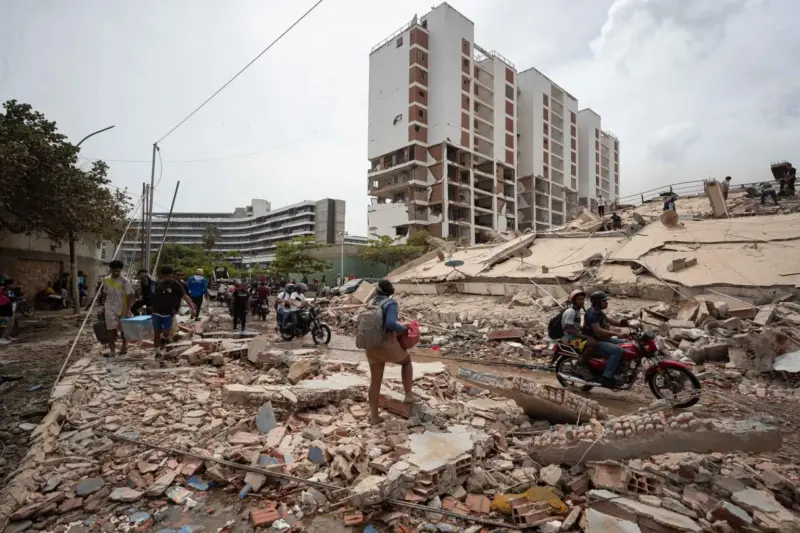
HAVANA TIMES – The earth shook in Venezuela—twice. It did so with such force that it fractured what remained of a State that had already been reduced to rubble. Shocked by the complete absence of authorities and abandoned in their desperation, citizens took to the streets to rescue their loved ones. Without civil protection brigades, without firefighters, and without heavy equipment, they relied solely on their own hands until they were stripped raw. During the first 48 hours, they searched blindly for both the living and the dead. Now, as the fourth day arrives, the full magnitude of the tragedy has become impossible to ignore.
An earthquake is a natural event. But what happens before and after is political. If there are no rescue units, if there are too few firefighters, if infrastructure crumbles from years of neglect, and hospitals have been stripped bare, the earthquake ends up exposing a deeper political history: the complete abandonment of the common good.
During Nicolás Maduro’s years in power, more prisons were built than health clinics, and far more torture centers than properly functioning hospitals. Add to that the preceding years under Hugo Chávez, and the result is 27 years during which the nation never stopped trembling.
Before the buildings collapsed, Venezuela’s institutions had already fallen. Because there are things for which the regime is unquestionably responsible: the destruction of the healthcare system; corruption; censorship and the blocking of media outlets and social networks. Likewise, international isolation (in 2024 Venezuela severed diplomatic relations with Costa Rica, Chile, Argentina, Peru, Panama, the Dominican Republic, and Uruguay); and the exodus of eight million citizens who have fled a country impoverished in its most basic economic indicators and devastated in terms of civil liberties.
In just fifteen years, Venezuela has undergone one of the greatest processes of material, moral, and political impoverishment in modern history. The Venezuelan State’s capacity to respond to a catastrophe is as weak as its democratic spirit and its respect for human rights. A government that persecutes dissenters, tortures, kidnaps, steals, and represses does not regard any human life as valuable. This time, it has demonstrated that once again.
Those who conceive and shape a nation as a prison—a place of punishment and surveillance—can hardly understand the obligation to provide aid and rescue. The courage of ordinary citizens, and the resilience of Venezuelan society in the face of the hardships it has endured, do not diminish one undeniable truth: the illegitimate and authoritarian government that Delcy Rodríguez has maintained since handing Maduro over to the United States is nothing more than an empty shell, an enormous coffin. The regime is now trying to control the flow of aid to a society battered first by its rulers and now by nature.
Published in Spanish by Confidencial and translated and posted in English by Havana Times.