
Neighborhood News
By Eduardo N. Cordoví Hernández
HAVANA TIMES – This is a synopsis of events that, over the past several days, have become—and continue to be—among the most talked-about topics in my neighborhood.
Here we go…
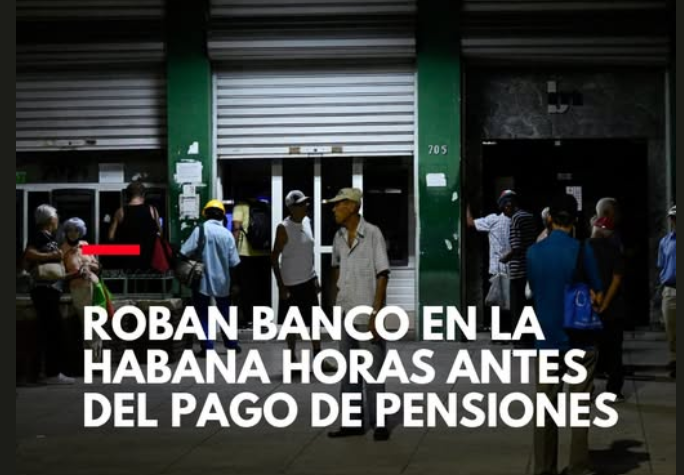
At the beginning of the week that started on Monday, June 15, two unusual crimes took place along Dolores Street in Lawton, and a third occurred in Santos Suarez. Although Santos Suarez is not my neighborhood, it is close enough.
What made these incidents extraordinary is that the targets were three major facilities: two banks—the Lawton branch and the well-known Banco de los Colonos, located on the ground floor of the imposing apartment building at the corner of Lacret and Juan Delgado, a place familiar to practically every Habanero, just a few meters from the former Los Ángeles and Mara movie theaters.
I don’t know the precise details, but people tell me the thieves took advantage of the nightly blackouts and removed the ATMs that face the street in order to gain entry to the buildings. I imagine a gang of specialized technicians, equipped with fast transportation and professional tools. Cuba has always had theft, but it was usually clothes stolen from clotheslines, opportunistic thefts, perhaps the occasional strong-arm break-in at neighborhood ration stores, warehouses, or homes, even at CADECA currency exchange offices—but not banks. Bank robberies were something you saw on Saturday night television, in Hollywood movies.
The other crime in Lawton took place at the former Santa Marta convent, now a state-run nursing home. It is a huge two-story complex occupying just under one hectare. Well, some guys simply came along, removed the solar panels, and that was that!
Actually, I’m not interested in the factual details of the news story. What interests me is the neighborhood commentary—that’s where my information comes from. The journalistic or news value isn’t what matters here. Rather, it’s the emotional imprint left by neighborhood gossip, and showing how people’s creativity evolves, advances, and flourishes when the means are available and spirits are stirred by the irrationality of a society suffering a total collapse of values.
Meanwhile, the blackouts have intensified. Among the many defining features of the revolution that dawned in 1959 have been two especially notable ones: Fidel’s marathon speeches and the power outages. Suffice it to mention that he was awarded a Guinness World Record for his 4-hour-and-29-minute speech at the UN on September 26, 1960, although he later delivered two speeches in Cuba lasting more than seven hours (one in 1986 and another in 1998).
Blackouts have appeared in countless Cuban and foreign films for decades, as well as in contemporary literature—not to mention the news media. Well, the outages are now raising the bar to dangerous levels. They have become routine, lasting an outrageous 12, 18, or even 22 hours, with no regard for any announced schedule. And they are now occurring in Central Havana, Vedado, and Playa alike. Even Old Havana—which, thanks to its underground electrical system, had seemed to be spared—has joined the “trend,” although local residents do not appear particularly pleased to have been included.
Another thing that has increasingly caught my attention is the growing number of people who, while still living in Cuba, are posting highly critical comments on Facebook, openly expressing their complete dissatisfaction with the government’s performance. Personally, I had already noticed this long ago in people’s outspoken public conversations. But everyone knows that “words are carried away by the wind”; writing them down is something entirely different.
Without a doubt, everything that is born eventually dies—sooner or later. There is no changing that, no arguing with it, no turning the page. But when so many people pin their hopes for a better future on something finally coming to an end, it creates a sense of expectation, of waiting, of anxious anticipation. Especially after so many prophecies have already been made…
Not long ago, I heard someone say that Cuba has become like the people of Israel during the Diaspora, promising every year, “Next year in Jerusalem”—or worse still, forever waiting for the arrival of the Messiah… Still!
Read more from the diary of Eduardo N. Cordovi here on Havana Times.