
What Led Me to Write “The Optimistic Cuban”
HAVANA TIMES – I live in New York’s Hudson Valley, two hours north of New York City. On one of my countless trips to Miami to see family, celebrate Nochebuena, and drink too much, I had a long conversation with one of my cousins (actually the son of one of my first cousins—there are about twenty of his generation). He, like his peers, was born in the US. I, like his parents and that whole older cohort, was born in Cuba.
Because I spent part of my childhood in Havana in the ’50s, after Fidel Castro’s takeover, I witnessed the transition from Batista’s despotic and ruthless dictatorship to Castro’s communist one. I was therefore able to tell my cousin of the conditions in Cuba’s pre-communist days. These conditions, I explained, which included extreme poverty and illiteracy, laid the foundation for the population to not only accept, but enthusiastically welcome a political change, no matter the warning signs.
The new government, led by Fidel and Raul Castro, and briefly also by Che Guevara, soon was as ruthless toward dissidents as Batista’s had been. Of course, my young cousin already knew this last part, having heard time and again from the older generation about the oppressive communist regime. But when I explained the social conditions in place before 1959, a little light seemed to go off in his eyes. At that moment, he readily understood that the majority of the Cuban population, promised free housing, education and material goods they had never had, chose to overlook the warnings of the new tyrannical government.
I walked away from that conversation newly aware of the gap in knowledge that many Cuban Americans have about their parents’ history. Their animus toward the Cuban communist regime is perhaps a parroting of family lore, without any real knowledge of what specifically happened and why. I decided I had to write about what I knew, what I had witnessed, and the reasons for the cataclysmic political upheaval in Cuba in 1959. For anyone with an interest in the Pearl of the Antilles, the Latin American country with the highest standard of living in the 1950’s, a document detailing the social (and not just the political) dynamics was needed.
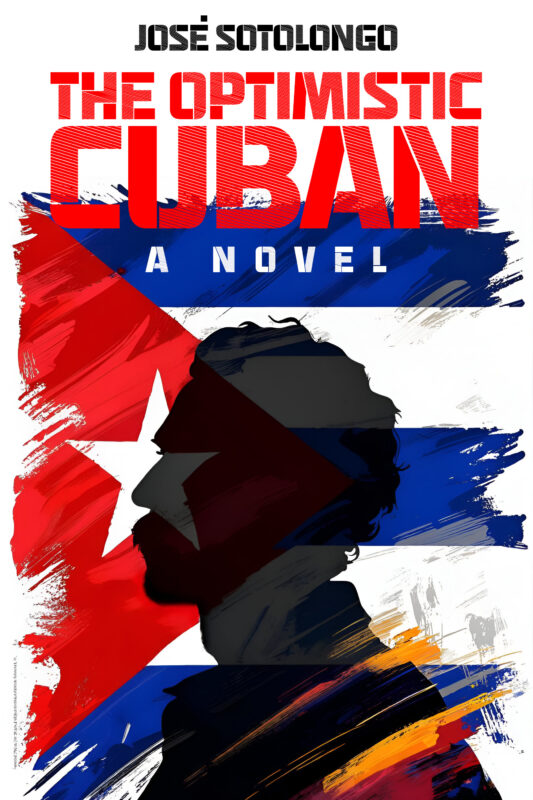
In my novel, The Optimistic Cuban, we connect with Fernando, the protagonist, who is a law student under Batista’s rule. Learning about his country’s disastrous political record of dictatorships and political oppression, he longs for democracy. His protests against Batista’s government place him and his fellow student collaborators at great risk of torture and assassination. Still, they persist, and in the novel we witness the consequences, some of them with life-long physical and emotional impacts. When Castro’s revolution succeeds, he is at first ecstatic, despite his savvy parents’ skepticism.
Fernado’s father is arrested during the Bay of Pigs invasion, along with hundreds of other men in Havana who are suspected of being unsympathetic to the communist government. This proves critical in furthering Fernando’s skepticism toward the new government. However, he remains loyal to his girlfriend and best friend, both of whom are Black and remain enthusiastic about the communist regime. Fernando has to navigate between the emotional attachments to his friends, and the country that he absolutely loves, and his family. In the end, emigration is an option, but not without great trepidation.
The feedback I have had from my family, particularly my second cousins, all now in their forties, fifties, and even sixties, has not disappointed. I had tears in my eyes at the end, a cousin I see only occasionally wrote me. And it brought tears to mine.
*Born in Cuba and reared in the US, José Sotolongo has been writing since age ten. His fiction and poetry have been widely published in literary magazines and have been nominated for the Pushcart Prize and Best of the Net. He is the author of The Optimistic Cuban (Histria Books), a historical novel about the Cuban Revolution of 1959. He lives on a goat farm in the Catskill Mountains of rural New York.
Gracias por tus palabras, Ignacio. Muy acertadas.
Awesome novel about that time and space between dictatorships that destroyed so many Cubans — and totally awesome response by the author’s brother.
For a more involved, less rushed, cleaner and polished version of my comment. Please visit the FB page.
I’m the younger brother of the author. The novel engulfed me with bursts of emotions. Drawn into its web, I struggled with the main characters emotional and irrational decisions. I relived my older brother’s departure (the author) from Cuba, I was not yet 4 years old. At the time not knowing why he left and later told by our nanny his departure was because I was a “bad” boy. It would be 4 years before I would see him again. A traumatic stake in the heart and experience, with lifelong effects to overcome. A work in progress. The novel is about the journey of a young man who has lost his mind and way for an idealistic better future of the land he was born on. Making regrettable mistakes, yet again in his own mind he believes a greater responsibility for the future. This mindset layes ahead whilst abandoning his own family. This is a must read for anyone who lived through that period or just heard stories from the older generation. More importantly, a must read for all those who have visions of a different future or their own idealistic society. Never underestimate the importance of present day life and how much we all need to share our thoughts with each other, not losing sight of what is truly important and what is not. Don’t believe everything you hear, read or told. Nothing comes easy or is it free. We live in a democratic country where we the people have a choice to choose whom we want as our president, yet, despite the choice or party chosen, we have very little in the way the country is run.