
Cuban Communist Party Recognizes Raul Castro’s Grandson as Key Negotiator with USA
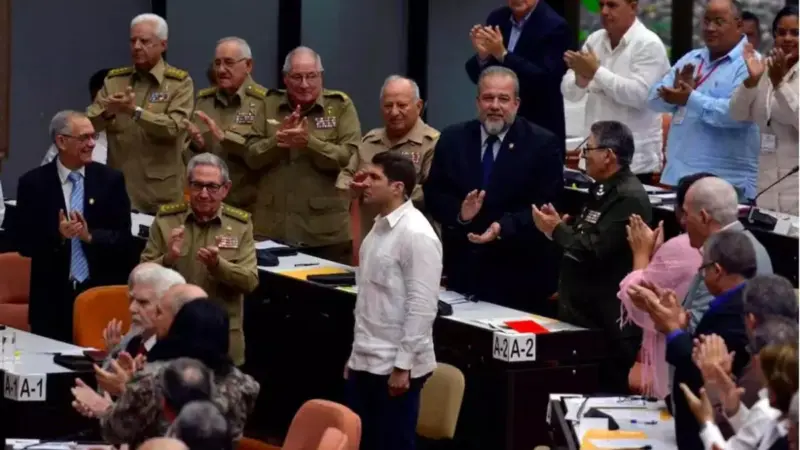
The Cuban establishment is divided over criticism of Raul Castro’s grandson, while prime minister, Manuel Marrero, calls for unity: “Character assassination, manipulation, and calls for division and fracture are part of a well-designed plan.”
HAVANA TIMES – The tacit support of Cuba’s Communist Party (PCC) and the government for Raul Guillermo Rodriguez Castro’s role as a key figure in negotiations with the United States became explicit on Thursday. El Cangrejo (“The Crab”), as the grandson of former President Raul Castro is known on the island, received an unmistakable endorsement from the PCC through Elier Ramirez Cañedo, an official in the Ideological Department of the Communist Party’s Central Committee.
The party official forcefully rejected the numerous criticisms directed at the young Castro from within the regime itself and made the government’s position unmistakably clear halfway through his post. “The manipulation and lies, the yellow journalism surrounding Raul Guillermo, as Cuba’s negotiator, by decision of the country’s highest leadership, respond to that objective,” he wrote.
Last Monday, the US newspaper USA Today published an extensive profile based on two interviews with Rodriguez Castro, people close to him, and experts on Cuban politics. The article portrayed the general’s grandson as someone groomed by his grandparents, for whom he expressed genuine admiration—as well as for his great-uncle Fidel Castro—aware that he had lived a life of privilege and convinced that he could help Cuba prosper through negotiations with the United States.
The article struck a nerve among some regime supporters, who were uncomfortable with Rodriguez Castro’s prominence and with the choice of someone who is technically outside Cuba’s formal political class. Maria del Carmen Hernandez, the mother of Miguel Díaz-Canel’s communications chief, openly lashed out in a post that many believed had the tacit approval of the presidential circle.
“Why is this young man giving interviews and assuming a role that does not belong to him? (…) Could someone please bring this young man back down to earth? Could someone tell him to keep quiet?” she wrote. The post also suggested that “Cuba’s enemies” were behind the situation, seeking to reinforce the narrative that only members of the Castro family have a voice in Cuba and thereby diminish the president’s authority.
A similar view was expressed indirectly by Israel Rojas, one of the musicians most closely associated with the regime. Responding on Facebook to a post by historian and journalist Ernesto Limia, Rojas argued that “No personal familiarity or informality on the part of a revolutionary leader can justify bypassing—even symbolically—the country’s institutions.”
Rojas, one half of the duo Buena Fe, lamented that Castro’s grandson represents precisely the kind of person who contradicts the ideals of the Revolution. He contrasted him with “men and women who bear the burden of the blockade and our own internal blunders. People far removed from luxury, yachts, indecent gifts, and VIP areas.”
The situation shifted dramatically after Elier Ramírez Cañedo publicly defended El Cangrejo’s appointment while accusing the US press of trying to undermine negotiations that, he argued, should have remained discreet.
“What marks a break with the past is that the current US administration has been neither serious nor discreet during the process, provoking leaks that put the talks at risk and create uncertainty about its true intentions,” he wrote.
Although Rodriguez Castro himself voluntarily spent several days with USA Today journalists, Ramirez referred to the interviews as part of “a media operation from the United States aimed at promoting a narrative of division within our country’s leadership, including character assassination—something that is nothing new, but which takes on greater significance in the context of Cuba’s current crisis.”
Despite receiving overwhelming support online, many commenters demanded an explanation for why El Cangrejo had agreed to the interviews.
“But this man’s public appearances are real, including in our own media. So isn’t someone supposed to explain something to the Cuban people? Trust is not something you ask for blindly, it has to be earned,” one user wrote.
Another commented: “The interview is a total disrespect toward the Cuban people and their intelligence. If the interviewee is truly playing a real role in sensitive negotiations and his work was supposed to remain secret, he could simply have refrained from speaking publicly with such arrogance and carelessness. And if he made a mistake, then it is up to the country’s leadership to clarify whatever needs to be clarified. The country belongs to all of us, not to a small group of chosen people.”
Former Culture Minister and former president of Casa de las Américas Abel Prieto, however, praised Ramirez’s statement on Facebook.
“Thank you, Elier, for that precise and necessary text. Today more than ever it is essential to preserve unity and avoid falling into our enemies’ traps. They shall not pass!!!”
The disagreement eventually reached Prime Minister Manuel Marrero, who posted remarks on social mediia on Thursday that closely echoed Ramirez’s message, suggesting his endorsement of the official line.
“As President Miguel Diaz-Canel has stated, in keeping with the Revolution’s consistent policy, conversations have been held with representatives of the US government aimed at seeking solutions to our bilateral differences through dialogue,” Marrero wrote in a brief thread.
The prime minister went on to say that it is not “the practice of the Revolution’s leadership to respond to speculative campaigns” concerning such sensitive matters and that “the team entrusted with this strategic responsibility enjoys the confidence, support, and mandate” of both Raul Castro and Díaz-Canel.
“Character assassination, manipulation, and calls for division and fracture are part of a well-designed plan to generate uncertainty and distrust. Every step taken at this decisive historical moment is in defense of the Revolution and our sovereignty.”
Given the similarities between Marrero’s comments and Ramirez’s earlier statement, many interpreted the message as an implicit confirmation that, without naming him, Marrero was acknowledging that El Cangrejo is indeed the regime’s designated negotiator.
On Friday, USA Today reported on the controversy and also consulted its own sources.
“Many Cubans were caught off guard this week by Rodriguez Castro’s freedom to speak openly about delicate diplomatic negotiations,” said Michael Bustamante, a history professor at the University of Miami.
Bustamante believes there is confusion within the Cuban establishment over El Cangrejo’s prominence, but says the acknowledgment that he is the key figure is now undeniable. The newspaper also notes that Castro’s grandson is virtually the only member of the Cuban leadership and its families who is not under US sanctions.
“There is this question: ‘Who is this guy, speaking this way? Has he fallen into a trap? Is he the person US media have chosen to sow division?’ This open way of handling things is not consistent with the style and discretion that have historically characterized Cuban diplomacy. But the reality is that no one has denied it,” Bustamante said.
The astonishment was also reflected in comments by former Cuban diplomat and former ambassador to the European Union Carlos Alzugaray, who responded directly to the USA Today article.
“I cannot believe that any level of the Cuban leadership authorized something so blunt and clumsy regarding such a delicate matter.”
First published in Spanish by 14ymedio and translated and posted in English by Havana Times
After all, the Castro family has spent 65 years building their empire and needs a family member negotiating their interests and guaranteeing wealth is secure. Once that is done, we can talk about food, fuel and medicine for the peasants.