
After 17 Days, Families Continue Searching in Venezuela
“I Won’t Leave Here Until I Bring My Sister Out” said one Vargas resident.
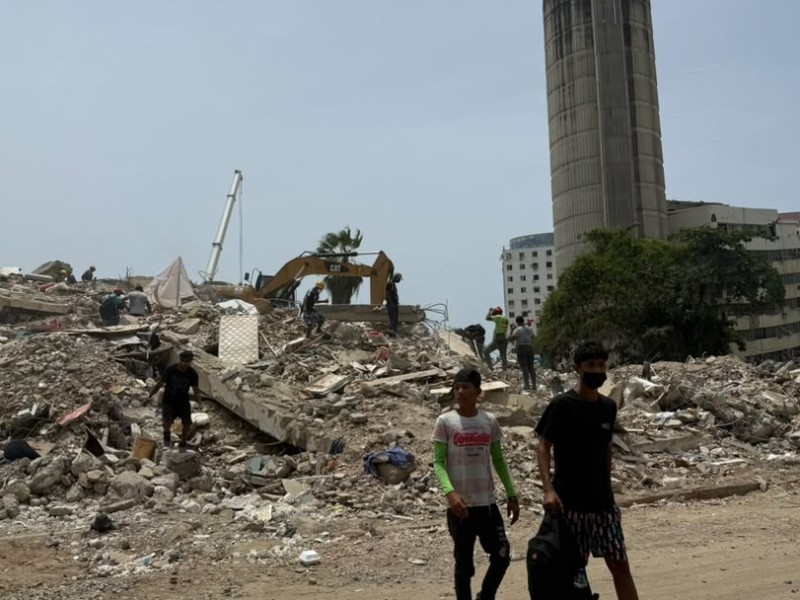
Residents complain that military personnel are not helping remove rubble by hand.
By Reynaldo Mozo Zambrano (Efecto Cocuyo)
HAVANA TIMES – Hope of recovering the victims—whether alive or dead—remains alive in La Guaira. Seventeen days have passed since two earthquakes caused Venezuela’s worst natural disaster in the past 27 years, and hundreds of residents of Vargas state are still searching for their loved ones beneath the ruins of what had been their homes until the afternoon of June 24.
Enduring temperatures of up to 35°C (95°F), and with virtually no chance of finding anyone alive, many continue to cling to the possibility of a miracle. Among them is 48-year-old Giancarlos Cardenas, who has spent the past 17 days under the blazing sun in front of the rubble of the apartment complex where one of his relatives lived.
From the moment the ground stopped shaking, Giancarlos, who lives in the parish of Naiguatá, has had only one purpose: to remove the concrete with his own hands in search of his 49-year-old sister, Luz Joahan Cardenas, who lived alone in the OPP26 housing complex of the Gran Mision Vivienda Venezuela development in the Caribe neighborhood.
Giancarlos knows time is working against him and that, after more than two weeks, hoping to find her alive defies all medical logic. Even so, for him, the true rescue goes beyond survival. He does not want his sister’s body to remain buried beneath the rubble and become just another number in the statistics of the missing.
“I know how this works and how many days have passed, but I’m not leaving here until I bring her out. Alive or dead, I need to find my sister’s body so I can have peace, give her a dignified burial, and know that I didn’t leave her alone in that building. Only then will I be able to close my eyes and truly rest,” Luz’s brother said.
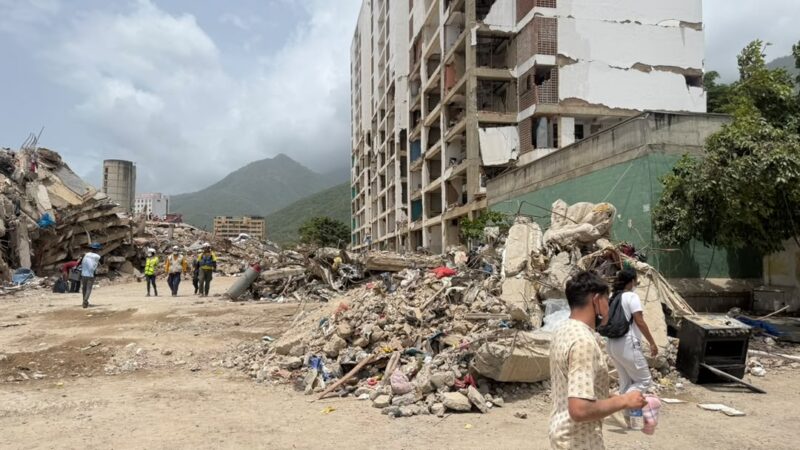
Waiting at Tower B
The emergency at the OPP housing complexes of the Gran Mision Vivienda Venezuela in the Caribe and Tanaguarena neighborhoods has become even more challenging because of the high population density these buildings housed before the earthquake.
At Tower B of OPP26, survivors and immediate family members have maintained continuous search efforts since the first day of the tragedy. The lack of machinery in key areas has forced them to continue removing structural debris themselves, with very little technical assistance.
Thirty-year-old Julissa Rivera, another victim of the disaster, is also waiting for the recovery of the bodies of her husband, her three brothers-in-law (ages 29, 27, and 15), and her 52-year-old mother-in-law. As of the afternoon of Friday, July 10, none of them had been found by rescue teams or by civilians working in the area.
“What keeps me going is finding them—whether alive or dead—but giving them a proper burial. Just finding them. I don’t want them to remain buried beneath all that rubble. I don’t want to leave them abandoned there,” she said firmly.
Her complaint is shared by many residents of this area of La Guaira and focuses on how rescue resources have been allocated. They insist that heavy equipment has been concentrated along the main roads rather than at the large apartment buildings, where the number of people trapped is far greater.
“What we’re going through is unbearable. I wouldn’t wish it on anyone, not even my worst enemy. A lot of people lived here… The authorities are here helping now. If they recover a body, I go and, if they let me, I look to see if it’s one of my relatives,” Rivera added.
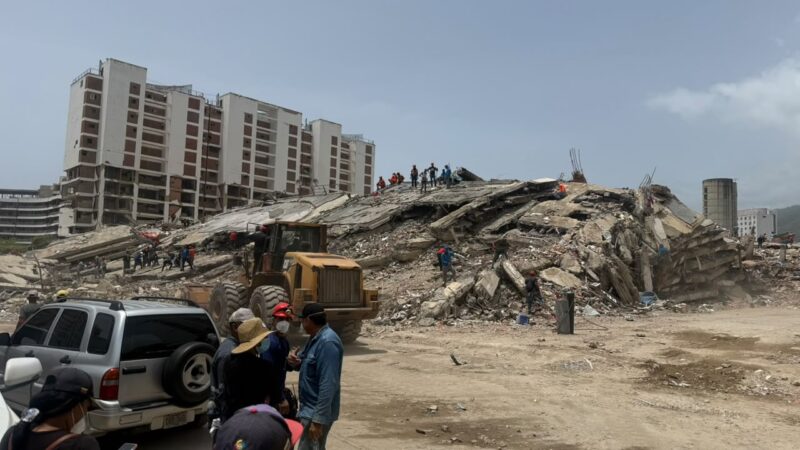
Residents Criticize Military for Not Helping with Manual Debris Removal
Since June 25, 50-year-old Gustavo Magallanes has been at the ruins of the OPP22 complex in the Caribe neighborhood. Magallanes, who is from Caracas and travels daily to the disaster zone, continues searching for relatives who remain trapped beneath the rubble.
Although his family recovered the body of his 76-year-old aunt, Alicia Magallanes, relatives still trapped inside the collapsed building include his cousins Mariana Rodríguez, 57, Milagros Matos, 55, Milagros’s husband Jose Perez, 66, and his five-year-old nephew, Matías Medina.
Removing the concrete slabs at this particular site has depended almost entirely on the manual labor of neighbors and family members because of the lack of specialized equipment.
Magallanes said the government response did not include sending large excavators equipped with hydraulic breakers to this multi-family building.
“We saw that in buildings that had already been sealed off there were two or three machines working. We understand that many belonged to private companies and others had been paid for by families. So you don’t understand what the government’s policies are. If there are going to be two machines over there, there should be two over here, because everywhere people are searching for both survivors and bodies. Maybe we could have saved more lives if we had had those machines from the very beginning,” he said.
Magallanes added that the shortage of heavy machinery was compounded by the absence of military work crews assigned to physically dig through the rubble with picks and shovels—a task that family members and neighbors have been carrying out on their own since the emergency began.
He also criticized military personnel stationed around the site for limiting themselves to security, traffic control, or distributing supplies. While he acknowledged those duties are necessary, he insisted that troops have not been systematically integrated into the physical work of clearing debris. Combined with inadequate lighting and the lack of basic services, this has brought nighttime recovery efforts to a near standstill.
Frustrated by the lack of an effective operational response, Magallanes recalled that one week earlier residents of the OPP complexes blocked the main avenue connecting Caribe and Tanaguarena in order to force authorities to divert the first excavator to their neighborhood, exposing major coordination failures on the ground.
“We see that there’s no coordination. One group of soldiers leaves, and another should arrive with picks and shovels to help us. I’m not a politician, but sometimes political decisions can cost many human lives,” he said.