
The Empty Storefronts of Havana
The abandonment of the city’s former commercial district
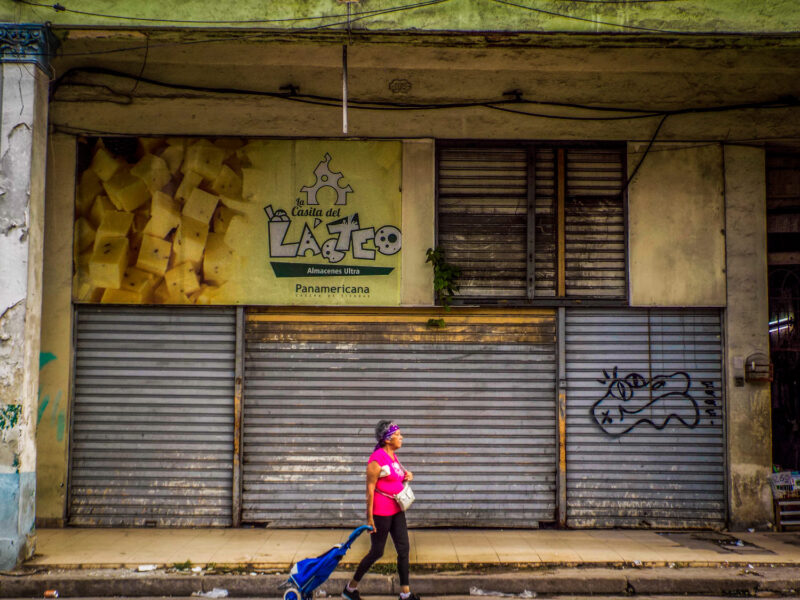
Photo Feature by Idania Cardenas
HAVANA TIMES – For nearly a century, Neptuno Street was the commercial heart of Havana. Today, many of its historic stores survive only as architectural skeletons, transformed into garbage dumps, empty warehouses, or crumbling buildings.
No one comes here anymore looking for a shirt, French perfume, or a set of English china. The display windows no longer reflect the elegance of a city that once rivaled New York, Mexico City, and Buenos Aires as a commercial center. Today they reflect something else: peeling walls, piles of trash, and buildings that seem to be waiting only for their final collapse.
For nearly a hundred years, Neptuno Street was one of Cuba’s most important shopping avenues. An old advertisement summed up its prestige: “There’s no need to leave Neptuno to find what you’re looking for.” It was no exaggeration. Shoppers could buy everything from haute couture dresses to typewriters, RCA Victor radios, English dinnerware, and the latest toys imported from Europe and the United States.
Today, walking those same blocks produces a feeling that is difficult to describe. Visitors find facades that still bear their original names: Roseland, La Filosofía, Almacenes Ultra, La Epoca. But behind those surviving signs there is nothing but emptiness and decay.
This is not merely the abandonment of buildings. It is the abandonment of a city’s commercial memory.
La Filosofía: a store that survived for nearly a century
Few people realize that La Filosofía was already a celebrated establishment while Jose Martí was still alive. Founded around 1867, it occupied the corner of Neptuno and San Nicolas streets and became the country’s leading department store specializing in women’s goods. It imported merchandise directly from the United States and Europe, filled mail-order requests throughout Cuba, and maintained traveling sales representatives who promoted its products across the island. More than fifty employees worked in its spacious showrooms, where customers were attended to in English, Spanish, and French.
By 1958, it ranked among Cuba’s premier department stores, with branches stretching from Matanzas to Guantanamo. Two years later, it was nationalized along with the rest of the country’s private retail sector.
Today it is a garbage dump.
Almacenes Ultra: modernity that disappeared
Opened in 1938 by Asturian businessman Cesar Rodriguez Gonzalez, Ultra represented the height of modern retailing: large sales floors, specialized departments, its own clothing production, and a corporate structure comparable to major US American department store chains. It eventually employed hundreds of workers and expanded with branches throughout Cuba.
Roseland
Located at the corner of Neptuno and Águila streets, Roseland was one of the best-known stores along Havana’s commercial corridor during the Republican era. Decades later, it was converted into a Panamerican Stores outlet and was eventually managed by the CIMEX Corporation as a hard-currency store.
Even in recent years, the building suffered from serious structural leaks that forced temporary closures. The photographs shown here capture an earlier stage, before its final abandonment.
Vernay, El cadete, Yumurí, and the forgotten stores
The history of Vernay, a former fur boutique on Neptuno Street, reflects the fate of dozens of small specialty shops that once made the avenue famous. Commercial directories from the 1950s list it alongside other stores that almost no one remembers today.
The same is true of El Cadete, Yumurí, La Mía, and many other establishments that were part of everyday life in Havana for decades.
Many were nationalized in 1960. Some reappeared during the 1990s under the Panamerican Stores network, whose outlets in the late 1980s had been known as the “Gold and Silver Stores.” These shops were created by the CIMEX Corporation to purchase jewelry and precious metals from the public in exchange for shopping certificates.
In connection with the 1993 Pan American Games, CIMEX was formally incorporated as a company with 72 retail outlets. From then on, it expanded rapidly, eventually operating more than 900 stores throughout the country and becoming one of Cuba’s largest retail chains.
The deterioration of these stores cannot be understood solely as an economic problem. Each one represents a chapter in Havana’s urban history. These were buildings where thousands of sales clerks, seamstresses, cashiers, and managers worked. They were places where generations of Cubans bought wedding suits, Christmas toys, or their first television set.
When these buildings disappear, it is not only the architecture that is lost. The settings where the everyday life of a city unfolded disappear as well.
The photographs accompanying this report do not simply document ruins. They document the slow fading of Havana’s commercial memory.
[ngg src=”galleries” ids=”2229″ display=”tile” animate_images_enable=”0″ animate_images_style=”wobble” animate_images_duration=”1500″ animate_images_delay=”250″]
Is there a cultural trait of learned helplessness in the Cuban culture? What in the different family backgrounds of the people of the 26th of July Movement created this complete mental and social stasis?
Don’t get too sentimental. The cause of this decay is communism. Which doesn’t work, sadly.
These old buildings were not built during the communist era – they were built during a period of advancing capitalism. Under communism they have been allowed to crumble to nothing.
Somebody needs to remove the deluded Cuban leadership, and free the people to earn a living and eat some food.
Remove by any means possible.
It was a nice experiment Mr Castro, but it didn’t work. Free Cuba!
It is really shocking and sad to see the decay of the Havana architecture. I remember walking around Galliano between Neptuno and San Rafael, and down San Rafael all the way to the University, a decade ago, and sections were stark looking then.
These photos here, plus others available on the net show how much worse it has become.
It is going to require astronomical amounts of money to restore these iconic buildings, and in La Havana Vieja, I just don’t see it happening anytime soon, and when renovations do begin to occur, my hope is that the solution isn’t just bulldozing everything.
So sad !! – Excellent atmospheric photography .. .. ..