
When the House Goes Dark, the Malecon Welcomes Havana
HAVANA TIMES – Havana nights have sounds that only appear when the lights go out.
The fan that stops turning.
The sudden silence of appliances shutting off.
The heat trapped inside the rooms.
The open windows searching for a breeze that doesn’t always come.
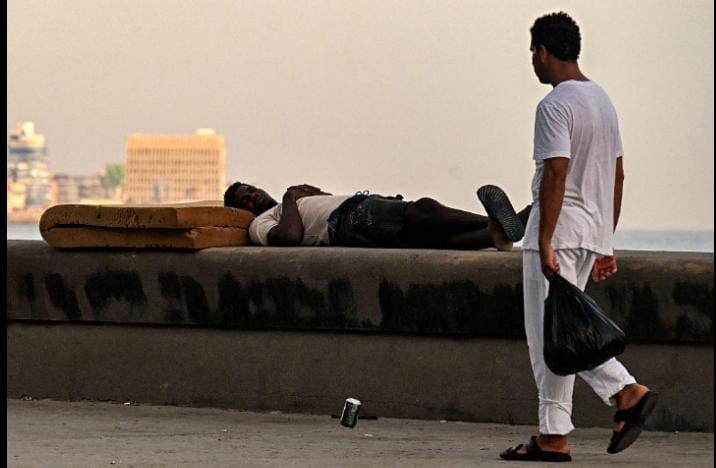
On one of those nights, a man sleeps on the Malecon seawall.
He didn’t come there because he has no home. He didn’t come because the street is his only option. He came because, like thousands of Cubans in the midst of a blackout, he needed to escape for a few hours from a home that had become difficult to endure.
On the concrete, facing the sea, he found something his home couldn’t give him that night: air.
At a quick glance, the scene could be mistaken for a different story. But the Malecón holds many stories, and not all of them are what they seem at first sight.
That man isn’t sleeping under the stars because he has been abandoned. He sleeps there because the darkness of a city without electricity also changes the way people live in their own homes.
When the power goes out, routines change. Living rooms become unbearable because of the heat, balconies and front porches fill with neighbors looking for conversation and relief, and some public spaces take on an unexpected role: becoming temporary refuge.
The Malecon seawall has always been that: a place that welcomes people.
For more than a century, it has witnessed life in Havana. It was built to protect the coastline and help shape the city’s growth, but over time it became something much greater than a structure facing the sea.
It became memory.
Entire generations have passed along its walls. Stories of love have been told there, along with farewells, gatherings of friends, endless conversations, and shared silences while watching the waves.
But the city also changes the way it uses its spaces.
Today, amid blackouts and the hardships of daily life, the Malecon once again reveals another of its functions: a place where people seek in order to endure.
It is not the first time Havana residents have turned the street into an extension of their homes. The city often forces people to find improvised solutions. A front porch, a sidewalk, a park, or a seawall facing the ocean can be transformed for a few hours into an open-air room.
The image of a person sleeping on the Malecón should not remain merely a photograph.
Behind it lies a question:
What happens when a city forces its residents to seek outside their homes the basic conditions they need to rest?
The sea continues to pound against the seawall as it has for decades. Havana continues to gaze toward the horizon that is part of its identity. But beneath that familiar image lies another city: the city of those waiting for the electricity to return, for a breeze to arrive, or for an all-too-long night to end.
Perhaps that is the true story of the Malecón.
Not only the story of the place where the city looks out to sea.
But also the place where, when the night becomes difficult, the city tries to find itself.
Read more from Safie M. González’s diary here at Havana Times.
Yes many memories there hoping that the trumpet music at 2 AM in front of my hotel had subsided!!!