
OAS Foreign Ministers to Discuss Elimination of Elections in Nicaragua
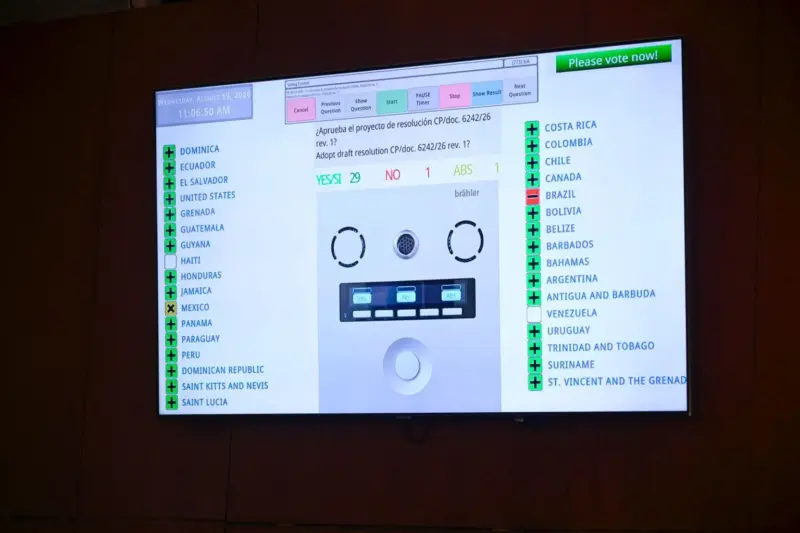
A total of 29 countries in the region backed the initiative promoted by the US delegation. Brazil opposed it and Mexico abstained.
HAVANA TIMES – A majority of countries on the Permanent Council of the Organization of American States (OAS) approved convening the region’s foreign ministers to discuss the situation in Nicaragua, where President Daniel Ortega announced on July 19, 2026, that there “will be no” elections in the country.
The meeting of foreign ministers was approved with 29 votes in favor, one against, one abstention and two absent. The vote took place during a special session of the Permanent Council held on Wednesday, August 19, 2026.
The call for the foreign ministers to meet is included in a resolution proposed by the US delegation in early August. The US initiative was backed by Antigua and Barbuda, Argentina, Bolivia, Costa Rica, Ecuador, Jamaica, Panama, Paraguay, Peru, the Dominican Republic and Trinidad and Tobago, among others. Only the Brazilian delegation voted against it, while Mexico abstained.
Considering that recent developments in Nicaragua “constitute a problem of an urgent nature and of common interest to the American States,” and that representative democracy “no longer exists in Nicaragua,” the OAS Permanent Council resolved to “urgently convene” a Meeting of Consultation of Ministers of Foreign Affairs “as soon as possible,” according to the approved resolution.
“The Situation in Nicaragua Has Crossed a Critical Threshold”
Uruguay’s permanent representative to the OAS, Edison Lanza, expressed his country’s concern over the “persistent deterioration of human rights, the closing of civic space, and the progressive erosion of democratic institutions in Nicaragua.”
He warned that the latest developments in the country are deepening “a situation that affects the democratic order” and is incompatible with the values of the regional organization.
“We believe that reducing pluralism through any banning of parties and political leaders, on the grounds that they allegedly committed crimes against national security, seeks to consolidate the ongoing persecution,” the Uruguayan ambassador stated.
Along the same lines, Ecuador’s permanent representative to the OAS, Monica Palencia, said that “the situation in Nicaragua has crossed a critical threshold.”
She warned that Ortega’s statement and the announcement of a constitutional reform permanently excluding the opposition “are an alarm bell.” These developments “represent a deliberate attempt to abolish the principle of alternation in power, eliminate political pluralism, and consolidate a regime that denies the Nicaraguan people their sovereign right to freely choose their leaders,” the Ecuadorian ambassador stressed.
OAS Must Not Remain Indifferent
Costa Rica’s interim representative to the OAS, Andres Vargas Ramirez, noted that the latest developments in Nicaragua “cannot be considered an internal matter,” since they affect the entire region. For that reason, he emphasized that the decision to convene the foreign ministers represents the organization’s determination “not to remain indifferent.”
Argentina’s permanent representative, Carlos Cherniak, said the broad support for the foreign ministers’ meeting demonstrates that “the OAS does not want to abandon its commitment to defending democracy.” He stressed the importance of letting the Nicaraguan people know that a majority of ambassadors no longer want to “waste time” repeating declarations that have already been made without producing any results.
“If a Nicaraguan authority decides to cancel elections and democracy forever in their country, can that be considered merely an internal political crisis?” the Argentine ambassador asked. “Isn’t a regime with those characteristics a potential threat to democracy throughout the region? Can silence, neutrality, or bureaucratic inertia be the way to respond to such a serious danger, or could they end up serving to maintain the status quo?” he questioned.
Second US Attempt
This is the second time in two weeks that the crisis in Nicaragua has been placed on the OAS agenda, despite the country no longer being a member state. The situation reflects the concern generated by Ortega’s declaration.
Ortega’s statements are “of an urgent nature and of common interest” to the American states, while “representative democracy, an indispensable condition for the stability, peace, and development of the region, no longer exists in Nicaragua,” said the delegations that supported the initiative.
On August 5, 2026, the OAS Permanent Council sought to “salvage the situation” during a special meeting by not putting the US-sponsored draft resolution to a vote. The initiative called for “declaring” the Ortega regime a “threat” to the hemisphere over the cancellation of elections in Nicaragua and for convening a Meeting of Consultation of the region’s foreign ministers.
Now the convening the region’s foreign ministers to discuss the situation in Nicaragua was nearly unanimously approved on August 19th.
First published in Spanish by Confidencial and translated and posted in English by Havana Times.
Most people already agree; now we need to establish a plan of action to address the very situation they view as detrimental to the countries in the region.