
Memories of Time: Havana’s Hotel Trotcha
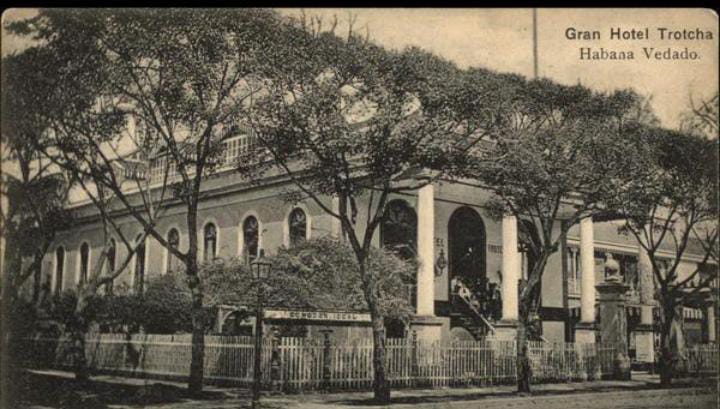
HAVANA TIMES – In Vedado, Havana, life goes on as if nothing had happened.
Cars travel along Calzada and 2nd Street, neighbors walk by, someone waits for transportation, someone else hurries across the intersection. The city keeps to its rhythm, that ability cities have to move forward even on top of their own losses.
But there was once a hotel there.
The Hotel Trotcha.
Today, nothing remains of its halls, its gardens, or the façade that endured for decades, like one last sign of another era. The space where that building once stood is now, above all, a place of memory.
An absence.
And perhaps that is one of the quietest ways important places disappear: not when their walls collapse, but when a city begins to grow accustomed to their no longer being there.
A Vedado resident, one of those who has watched the streets change over the decades, remembers the Trotcha the way one remembers someone who was once part of their life.
He does not speak of a building.
He speaks of a presence.
“The strangest thing isn’t that a building can be lost,” he says. “The strange thing is that one day you pass by the same place and have to imagine it.”
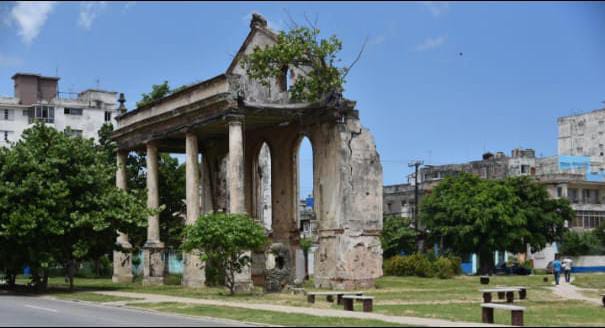
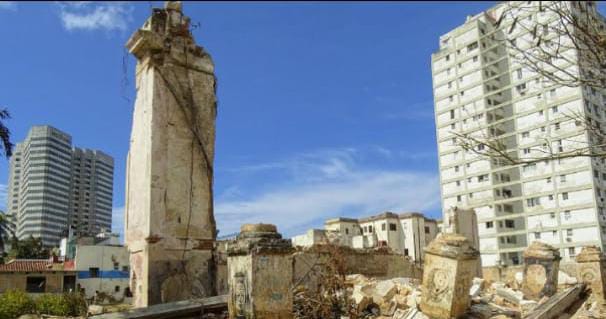
For years, the last columns of the old hotel remained there as a kind of resistance against time. After a fire destroyed much of the building in 1986, those ruins remained as a visible trace of an earlier Havana.
For many neighborhood residents, those columns were more than architectural fragments.
They were a landmark.
Proof that another city once existed on that corner.
Because a building is never just a physical structure.
It is not merely walls, roofs, or columns. It is also the footsteps of those who entered, the conversations that took place inside, the celebrations, the encounters, the small stories that rarely make it into books.
A building is also an archive.
And when it disappears, part of that archive disappears with it.
The Hotel Trotcha was born in a Havana that was beginning to look toward the future.
In the late 19th century, as Vedado was becoming one of the capital’s most modern neighborhoods, Buenaventura Trotcha opened a recreational establishment that quickly gained popularity. Over time, it expanded into a hotel, with guest rooms, a restaurant, reception rooms, and gardens.
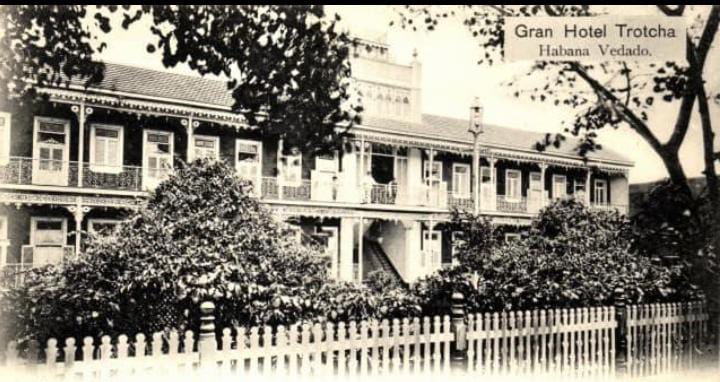
It became a gathering place for a city that wanted to present itself as elegant and cosmopolitan.
Accounts from the period describe its gardens, its meeting spaces, and the importance it held in Havana’s social life. Writers such as Julián del Casal left accounts of the impression the place made, then considered on a par with the great hotels of Europe.
But no city remains the same forever.
The Trotcha gradually lost its former splendor. Its use changed. The hotel ceased to be the gathering place it once was and eventually became a different kind of space within a Havana that had also changed.
Then came the fire.
And after that, time.
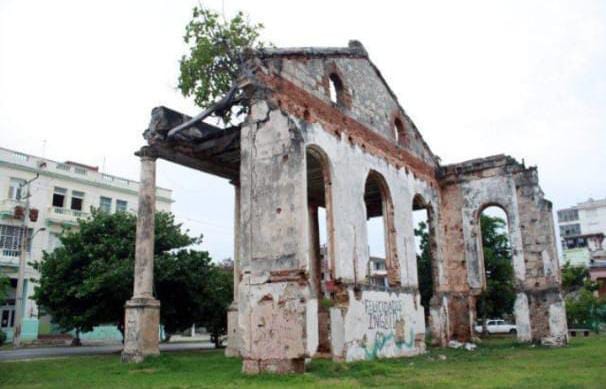
For years, the last remnants of the façade survived, until Hurricane Irma, in 2017, finally brought down the colonnade that had still been standing. With it disappeared one of the last visible traces of the old hotel.
But perhaps places do not disappear completely when they cease to exist physically.
Some remain in other ways.
In old photographs.
In the memories of neighborhood residents.
In that strange ability a city has to preserve images of what it has already lost.
Havana lives surrounded by those layers.
It moves over buildings that are no longer there, over names that survive even though the places themselves have changed, over stories that endure because someone is still there to tell them.
The Trotcha raises a question larger than its own disappearance:
What does a city lose when it loses the places where it built part of its memory?
Because a city is not made only of what remains.
It is also made of what it remembers.
Today, the Trotcha no longer has rooms to accommodate visitors, gardens where people can gather, or halls where music can be heard.
It has something different.
It has memory.
And perhaps that is the final form of resistance for some places: to disappear from sight, yet remain in the consciousness of those who still know they were once there.
Read more from Safie M. Gonzalez’s diary here on Havana Times.