
Life in Cuba When the Water Doesn’t Come
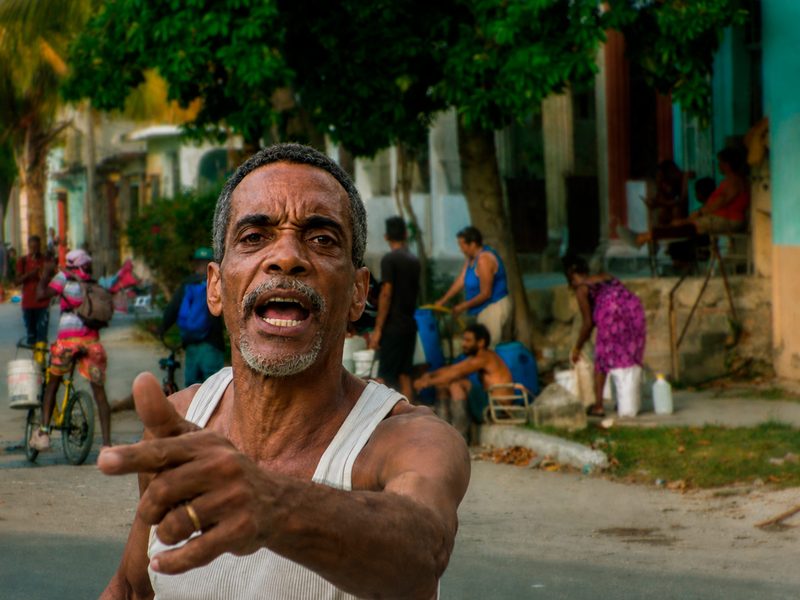
Photo Feature by Idania Cardenas
HAVANA TIMES – A man approaches the camera. He doesn’t ask to have his picture taken. He asks for something more: to be seen. “Take plenty of pictures, so the world can see how we’re living in Cuba and this whole fucking thing finally comes crashing down,” he says, pointing toward a street where several people are waiting to fill their water containers.
His words come out with anger, but also with exhaustion. Behind him, the scene speaks for itself: people carrying containers, jugs, and buckets; children helping adults; neighbors waiting their turn in front of the truck delivering water. An ordinary street transformed by necessity into a water distribution point.
Here, water doesn’t simply come out of a faucet. You have to wait for it. You have to go get it, carry it, and then decide how to ration it until it comes again. The lack of water has turned a necessity into a task around which many families must organize their lives. Empty containers line the sidewalks, and people learn to calculate how much they can carry, how much they can store, and how long what they manage to obtain will have to last.
In the midst of this routine are the children. One of them fills a container and helps out, as though the responsibility belonged to him as well. The image is difficult to separate from an uncomfortable question: How much of adult life begins to fall on the shoulders of children when basic necessities are no longer guaranteed?
There is no answer in the photograph, only a child doing what needs to be done. People wait, carry their water, and return home. Some walk through the streets with containers that weigh more than they appear to. Others wait for another opportunity to get water. And meanwhile, time slips away as well. Scarcity does not simply mean going without water. It means changing schedules, postponing tasks, storing, rationing, and constantly watching when the next water truck will arrive.
That is why these photographs tell more than just a story about water. They tell a story about how life changes when something so basic is no longer guaranteed. The man who stepped in front of the camera understood it in a different way. He didn’t talk about statistics or reports. He looked at the photographer and asked her to show what was happening. His plea was captured alongside the images of a community waiting.
Later, I came across firefighters using water to battle a blaze on a street corner. The scene involves a different kind of emergency, but once again water is at the center of the picture: the same resource a family needs to live is also indispensable for fighting a fire.
They are different images of the same city, overwhelmed by problems that continue to pile up. A water truck arrives and dozens of people wait. A container is filled and someone has to carry it home. A child helps. A man asks for photographs to be taken of what is happening, and firefighters rush to a fire.
In the end, perhaps the most powerful image is not that of a full container, but of all those people still waiting for the chance to fill one. Because when water stops coming out of the faucet, the waiting eventually finds its way into every home.
[ngg src=”galleries” ids=”2246″ display=”mosaic” animate_images_enable=”0″ animate_images_style=”wobble” animate_images_duration=”1500″ animate_images_delay=”250″ animate_pagination_enable=”0″ animate_pagination_style=”flipInX” animate_pagination_duration=”1500″ animate_pagination_delay=”250″]