
The Horizon in Our Hands
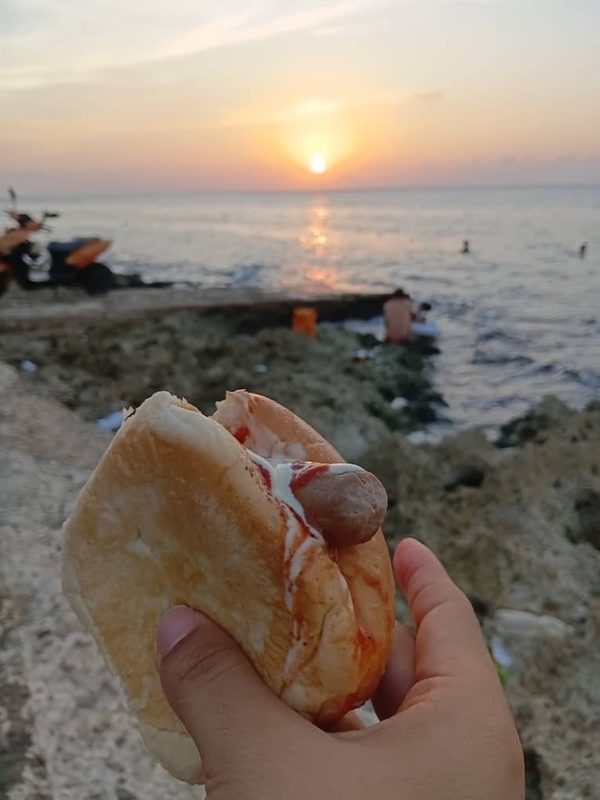
HAVANA TIMES – Sunset at 3rd and 70th in Havana’s Playa municipality has a kind of light that can’t be explained, only felt. It’s that hour when the sun turns orange and everything seems to come to a standstill, as if the entire city were taking a deep breath before nightfall.
There I was, sitting on the edge of the sidewalk, with a sausage sandwich in my hand and the horizon before my eyes. There was no table, no tablecloth, none of what people call service. There was a pushcart, a street vendor, and the certainty that after 48 hours without electricity, a Cuban woman isn’t looking for dinner; she’s looking for a breather.
The power still hadn’t come back. Two days, and the blackout continued. It wasn’t just the heat, or the refrigerator that hadn’t worked for two days, or the darkness that forced you to go to bed early. It was the soul on edge, waiting for something to return to normal. It was time broken, suspended, counting the hours without really knowing what you were counting.
The vendor knew me. I didn’t have to ask. He knew that with a blackout hanging over you, you’re not looking for a menu; you’re looking for the usual: bread, sausage, something cold to drink. It wasn’t a craving. It was a ritual, a way of telling yourself that even if the power doesn’t come back, the world keeps turning.
As he heated the sausage on his portable stove—thin, modest, with nothing to make it special—I looked toward the sea. Because at 3rd and 70th, if you look north, you can sense the horizon. Sometimes you can see it, sometimes you can’t, but you always know it’s there. And in that certainty, there is something that transcends the food, the blackout, the prices. There is something Cubans know well: the habit of looking out to sea when words are not enough.
The vendor handed me the sandwich wrapped in paper and the soft drink in my hand. There was no plate or silverware. I didn’t need them. I ate it directly, feeling the warmth still held by the sausage, the bread crumbling between my fingers. It wasn’t dinner. It was a communion with the simple, the everyday, with what is always there even when everything else fails.
The soft drink was cold. The container was covered in condensation, and the first sip went down and brought relief. In the middle of a blackout that refused to let up, a cold soft drink was almost a miracle. Not the kind preached from a pulpit, but the kind you give thanks for in silence, as your throat comes back to life and your fingers grow wet with condensation.
And as I ate and drank, feeling the sunset on my face and keeping my eyes on the horizon, I understood that I hadn’t gone there for the food. I had gone for the pause, for the silence, for the chance to sit on a curb and not think about the blackout, the prices, the country. I had gone looking for what we all look for when everything closes in: a moment when the soul can breathe, even if the power hasn’t come back.
A Cuban woman has that ability: to find peace in small things because the big things are broken. To sit on a curb, eat a sausage sandwich, and look out to sea as if looking at a dream. That Cuban woman isn’t making a denunciation. She is making an act of faith: faith that the sunset is free, that the coldness of the soft drink brings relief, that the horizon makes promises without asking for anything in return. Especially when the power doesn’t come back.
When I finished, I paid. The soft drink cost 500 pesos, the sausage sandwich was extra. I paid without complaining, because there was nothing to complain about. The vendor isn’t to blame for the economy. He, too, is looking for his peace, his horizon, his way of surviving.
I got up and threw away the paper and the container. Night had already taken over the street, and the vendor was beginning to pack up his cart. We didn’t exchange any words. None were needed. We looked at each other, nodded, and each went our separate way. He toward his home, I toward mine. Both of us in the darkness, both knowing that tomorrow the power might come back—or it might not.
But as I walked, something stayed with me. Something the blackout couldn’t take away. Something that wasn’t in the bread, or the sausage, or even the cold soft drink.
The sea was still there, waiting for me to look at it again.
Read more from Safie M. González’s diary here in Havana Times.