
The Nicaraguan Dictatorship Is a Poor Copy of North Korea’s
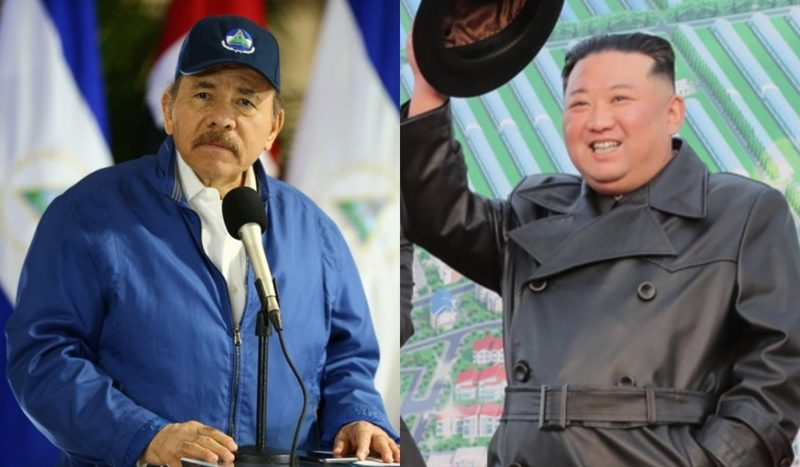
North Korea has had two dynastic successions, from Kim Il Sung to Kim Jong-il, and from Jong-il to Kim Jong-un. Ortega’s regime has had none.
By Silvio Prado (Confidencial)
HAVANA TIMES – Hereditary dictatorship was once an oddity among communist regimes—something more characteristic of late-feudal monarchies than of the left-wing movements that sought to overthrow them. That changed when the hereditary dictatorship of the Kims was established in North Korea in the mid-1970s, with the transfer from the first to the second generation at the Fifth Congress of the Workers’ Party of Korea. Until then, dynastic succession had been an anomaly. This father-to-son transition was possible because it rested on three pillars of power: one-man leadership (and the family), the military, and the party. Ortega’s regime appears to be following the same pattern, but lacking both time and institutional mechanisms, it will inevitably fall short.
Hereditary successions fit within the logic of principal-agent relations, in which the principal is the boss, “the person for whom or by whose authority action is taken” (Paul Brooker), while the agent refers to the subordinate, deputy, or person acting on behalf of the principal. Under dictatorships, however, when we ask who is in charge, the roles are reversed: the institutions—which should be the principal—become instruments of the dictator, while the dictator—who should be the agent—becomes the boss.
North Korea, unlike other neighboring communist regimes, has undergone two dynastic successions in 78 years: from Kim Il Sung to Kim Jong-il, and from Kim Jong-il to Kim Jong-un. Over roughly the same period, China has undergone five non-dynastic successions, while the Soviet Union had six in 74 years. Ortega’s regime, in 42 years (including the 17 years it was out of power), has had none. Until a few years ago, that is, when the dictator’s approaching end and the notable rejection of his now co-president wife set off all the alarms. Of the three pillars on which North Korea’s first succession rested—one-man leadership, the military, and the party—Ortega’s regime has managed to rely only on the family and the weapons of the state (including the police).
One-Man Leadership and the Challenge of the Second Generation
In North Korea, Kim Il Sung’s charismatic leadership was undeniable. Even so, such a closed regime encountered problems when it came time to pass the baton to his successor. His second wife (who was not Kim Jong-il’s mother) maneuvered to have her eldest son named heir, until Kim Jong-il, allied with the old guard of the party and the military, thwarted her plans. Some authors point out that Jong-il’s succession was the longest and best-prepared in history, considering that he was anointed the de facto successor in late 1973 and assumed the supreme position in 1997, following the three-year mourning period that he himself decreed after his father’s death in 1994. For nearly three decades, Jong-il held every possible senior position in the party and the military, where he bestowed upon himself and his sister the rank of four-star general.
Castroism tried to imitate them, but its designated successor, Luis Alberto Lopez Callejas, Raul Castro’s former son-in-law and the head of GAESA, spoiled those plans by dying (of COVID, a heart attack, or whatever it was) in 2022.
Ortega’s regime waited too long before putting forward its “chigüín” [kid]. Although it opted for bloodline as the line of succession, it could not transfer to him the charisma of the dynasty’s founder. Instead, it turned to tradition as a source of legitimacy, but the young man suffered from the same deficiency as his mother: a lack of credentials within the party and the military. Failing that, they tried placing him in public positions to get the population accustomed to him, but the fellow was not up to the task; his thing was the dolce vita: opera, Rolex watches, and Gucci suits. So, while buying time, they came up with constitutional reforms, a co-presidency, extensions of terms in public office, and other absurdities—and that is where things stand today. Delaying things longer will not make his résumé any more substantial.
In Cuba they failed to make the leap to the second generation; in Nicaragua they have not even made it to first base.
The Military
In North Korea, the military has always been the central axis for accumulating power. It was home to the most powerful elite, whose approval was necessary for Kim Il Sung’s successor. This was not merely the old guard; it was also the generation that had fought against the Japanese and later against the Americans in the Korean War. In addition, there were two potential sources of conflict: the internal struggles generated by the appointment of Kim Yong Ju, Kim Il Sung’s brother, as provisional successor, and fears that the internal succession struggles that had erupted in China following Mao’s death—the purges of the Gang of Four and Hua Kuo Feng, followed by the eventual rise of Deng Xiaoping—might prove contagious, along with the purges associated with Khrushchev’s de-Stalinization in the Soviet Union.
To put an end to these potential uncertainties, Kim Il Sung eventually appointed his chosen heir to the crucial Central Military Commission, and he would later be named supreme commander of the armed forces, as well as Hero and Great Leader of the country (as everyone knows, North Koreans are hardly stingy when it comes to grandiose titles).
By contrast, Ortega’s regime, despite knowing that the military is its most important pillar, has never tried to slip any of its descendants into the armed forces… until now. Patronage and perks have been enough to maintain the obedience of the high command and keep the ranks of the uniformed forces closed.
The Party
Here there are indeed similarities between the Workers’ Party of Korea and the FSLN. Although North Korea’s first and second successions were cooked up within the party, it gradually lost influence as the old guard disappeared with age. Every step in the succession processes was endorsed by plenary sessions of the Politburo, Central Committees, and Party Congresses, most of them orchestrated by Kim Jong-il through the Organization and Propaganda and Agitation departments.
After the first succession, however, Jong-il ordered the unification of the party and military leadership in favor of the latter, militarizing political positions and changing the label of the official doctrine from Juche (self-reliance) to Songun (military first). With such a dramatic shift, the National Defense Commission effectively supplanted the Party.
The party has also declined in importance in the major decisions of Nicaragua’s political regime, although for different reasons and through different processes. The FSLN has lost influence in inverse proportion to the consolidation of Ortega’s one-man leadership. Several authors date the beginning of the FSLN’s decline to the extraordinary congress of 1994, when Ortega seized absolute control of the party and began a process of deinstitutionalization, while internal oversight bodies were dissolved or rendered powerless. That marked the beginning of the death of the National Directorate and the Sandinista Assembly, along with the transformation of annual party congresses into almost anecdotal, half-day express gatherings held merely to “approve” decisions already cooked up at El Carmen (the presidential bunker). Today, no one in their right mind can claim that the FSLN exists as an institution with a life of its own.
Compared with North Korea, it is not that the party was absorbed by the military. It was swallowed up by the Ortega family. Unlike the Kim family, the Ortegas did not seek to insert their possible heirs into either the FSLN hierarchy or the military high command. Perhaps there are two reasons: first, like the matriarch, they have no pedigree in either institution; and second, it was already too late to sneak them in through the back door.
Although both dictatorships have designed hereditary successions by reversing the principal-agent relationship of institutions, North Korea, for historical and cultural reasons, prepared the process far in advance. Nicaragua’s dictatorship, however, improvised last-minute absurdities such as the “Chamuca (Murillo) Constitution,” which, seven months after being imposed, is already on the verge of being amended.
Two notes for the comedy:
- To legitimize the first dynastic succession, the North Koreans adopted the “Ten Great Principles for the Establishment of the Unitary Ideology System” in 1967. If you want a laugh, look them up online. It would not be surprising if they served as inspiration for Nicaragua’s next constitutional reform.
- According to the Dictionary of Political Terminology published by North Korea’s Academy of Social Sciences, hereditary succession was defined in 1970 as a “reactionary custom of exploitative societies by which certain positions or wealth are legally inherited.” In the 1973 edition of the same manual, the definition had been deleted. It is what Groucho Marx might have called flexibility of principles
First published in Spanish by Confidencial and translaed and posted in English by Havana Times.