
Cuban Theater: “Mothers, the Emptiness That Dwells Within”
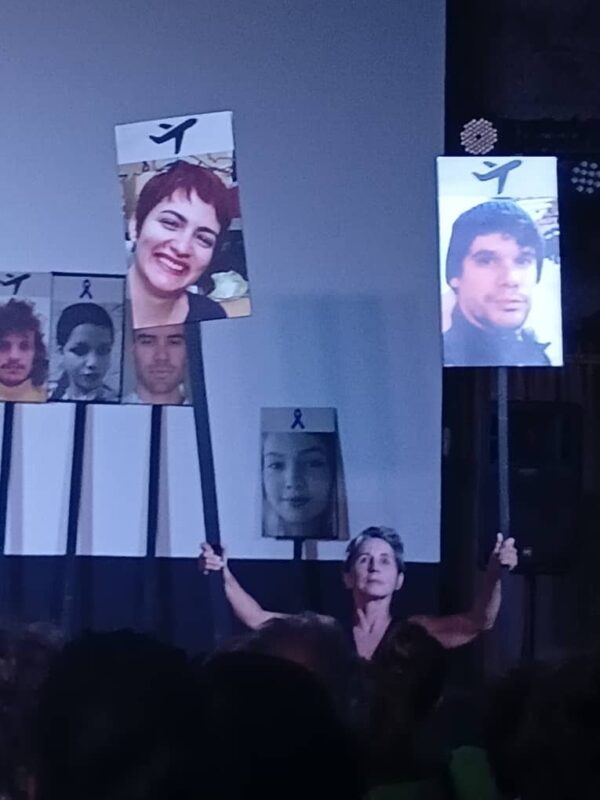
Photo Feature by Safie M. González
HAVANA TIMES – Some plays are seen. And some stay with you. Mothers, a play by El Ciervo Encantado, belongs to the latter. It does not end when the lights go out: it continues in that uncomfortable place where things remain that one would rather not look at for too long.
I saw it on July 16th at the Norwegian Embassy in Vedado, Havana. The room was small, intimate, almost domestic. A mansion on 21st Street, its windows open to the night, transformed for a few hours into a performance space.
There was no protective distance between the audience and the stage.
An actress occupied that nearly bare space. The images accompanying the performance used symbols to introduce different forms of absence: an airplane evoked those who had emigrated; handcuffs, those who remain in prison; another symbol evoked death by femicide.
These were not stories told one by one. They were signs.
And behind each one was someone who is missing and someone who remains.
From there, Mothers builds its world: around what is left when someone leaves, when someone dies, when a door closes and on the other side someone is left waiting.
The play does not need to explain very much. The symbols do their work, and the audience fills in what is missing with their own references, with familiar names, with stories that may belong to their own families.
Nor does the actress construct a conventional character. Her body seems to carry a memory that needs no biography. She moves forward, stops, waits. Sometimes a single gesture is enough to give absence a physical dimension.
It is not a peaceful kind of waiting.
It is the waiting of someone who does not know whether there will be a return, when it will happen, or whether it will ever happen at all.
The lighting frames the body with precision. There are not many places to hide. The face, the hands, the movements take on an intensity that makes explanation unnecessary.
The sound, too, does not function as ornamental accompaniment. It breathes, interrupts, creates tension. The scene seems suspended in that instant before something that should happen but never quite arrives.
There is something particularly unsettling about Mothers: it does not try to put pain in order.
It places it before us.
Motherhood then appears shaped by different circumstances, yet united by a common experience. The mother who remains has no control over what happened on the other side of the absence. She can only bear its consequences.
And that burden does not always have a name.
Sometimes it is waiting for a phone call.
Sometimes it is staring at a door.
Sometimes it is knowing that someone is far away.
Sometimes it is learning how to speak of a loss.
In a country where family separation is part of the everyday experience of many people, the play takes on a resonance that is difficult to ignore. But not because it seeks to represent statistics or explain a social reality. Its power lies precisely in the opposite: it reduces something enormous to a body, an image, a gesture, a wait.
Mothers arrived in that room after waiting two years. Its premiere, scheduled for 2024, had been indefinitely postponed by the cultural authorities. Now, far from the institutional stage, the play was once again meeting its audience.
The performance ended.
The applause was long, but not celebratory. Afterward, the audience slowly made its way out onto the street.
Outside was Havana.
And it was dark.
From some buildings in Vedado came the metallic sound of cacerolazos—people banging pots and pans in protest. The city was enduring another blackout, and the irregular clatter of pots and utensils striking metal began to blend with what we had just seen.
Inside the room, the mothers and their absences had remained. Outside, the city had absences of its own.
Perhaps that was why, that night, it was difficult to separate the play from the reality surrounding it. Mothers had not needed to go looking for the Cuban experience: it found it waiting just a few yards from the door.
People continued walking along 21st Street. The city remained in darkness.
Perhaps that was what remained of the play: not an answer, not even an explanation, but the certainty that there are absences that change shape and yet remain.
That night, after the performance, Havana switched its sounds back on before its lights.
And somewhere between the applause that had just ended and the cacerolazos that were beginning, Mothers found its stage.
[ngg src=”galleries” ids=”2251″ sortorder=”55011,55013,55014,55015,55016,55017,55012,55018,55010,55019″ display=”slideshow”]