
Notes on Begging in Today’s Cuba
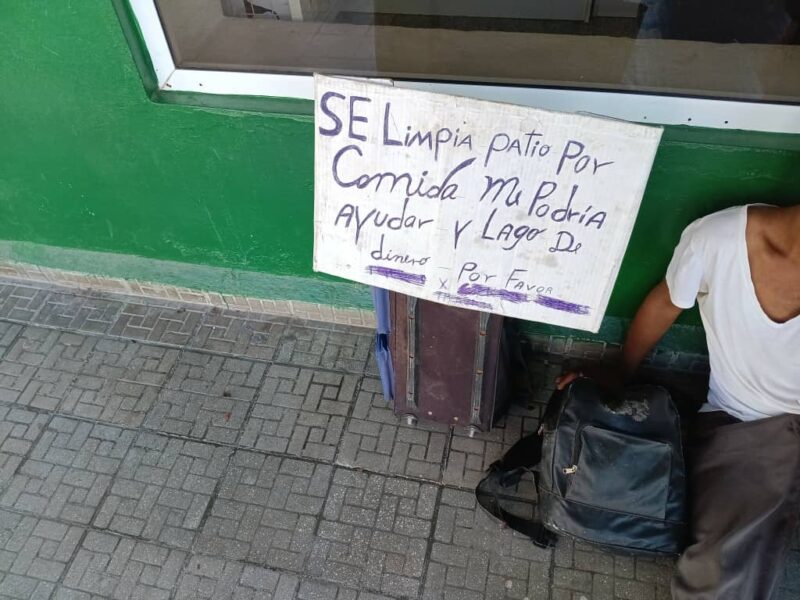
HAVANA TIMES — A friend told me about the moment he became fully aware of just how serious our situation had become. It was the day his neighbor stopped putting food out on the street for one of the neighborhood’s stray dogs. He told me that when he no longer saw that food sitting there, he said to himself, “We’re really in bad shape.”
There is simply no way to remain unaware anymore. Not only are the numbers of stray animals growing without the slightest protection, but so are the people living in homelessness and extreme poverty.
Walking through downtown Holguin these days—and it doesn’t take very long—you may be approached by three or four people asking for money. Most are men, both elderly and young. Some show obvious signs of addiction; others do not. In front of churches, on the streets, in parks, at small markets, on virtually every corner, someone stops you and asks if you can spare enough for a cup of coffee or to buy “a piece of bread with something.”
You search your pockets and realize you can no longer give the kind of alms you once did—five pesos, for example. Considering that a cup of coffee now costs around 50 pesos almost anywhere (and in restaurants or cafés it can cost more than 300), even 20 pesos may not be enough for anything. So you try to give 50 pesos. If you have less—because sometimes you aren’t carrying much at all—you give what you can, apologizing for how little it is.
The scenes we once associated with movies set in India—where crowds of men and women approach others asking for financial help—no longer seem so distant. Cuba is becoming that kind of place as well, overwhelmed by the sheer number of people on the streets asking, for example, for something to eat.
It is encouraging to encounter church teams handing out food, or independent groups carrying out charitable work, as well as individuals who take it upon themselves to help. But it is not enough. I find myself wondering: what is the government doing about this?
To witness this expression of poverty in our socialist homeland—after 67 years of revolution, something the Cuban Communist Party never tires of reminding us of—is no easy thing. Living in a country where the State constantly calls for and proclaims the need for “sacrifice for the common good” makes this reality all the more striking.
We were always taught in school that begging was a hallmark of the decadent capitalist system. Our system, we were told, guaranteed social justice above all else, where everyone would enjoy the same opportunities in life.
In recent years there has been no shortage of economic reforms. The government’s guidelines became a constant topic of daily life, as did endless meetings devoted to the country’s economic development. Yet here we are, confronted everywhere by this growing human wave of abandonment and destitution. It has to affect us. Deeply.
One friend tells me that this is no longer socialism—or anything at all. Another says, “This is simply a fiefdom. One family’s fiefdom, nothing more.” Whether we are a fiefdom or whether we are socialist, it is time to recognize what is happening.
Let the Government say what it will. For there is no worse remedy than ignoring problems. And we already know all too well the consequences of keeping quiet.
Gilgamesh throws up a smokescreen. Cuba is owned by a khaki mafia that has blamed all misery on the Yankees while the mafia lives quite comfortably. Donald Trump is taking away the crumbs that the khaki mafia throws to the peasants. It’s the only way to break the Cuban mafia.
Aw Lien. Sounds like you never heard of Donald Trump. Maybe, just maybe, some of that desperation might be a direct result of insuring that Cuba gets zero oil. An economy with no oil just might be a little difficult to run. No creas ? Anyway, nice story about the symptoms without any mention of the cause !