
We Are Just Pawns on a Chessboard
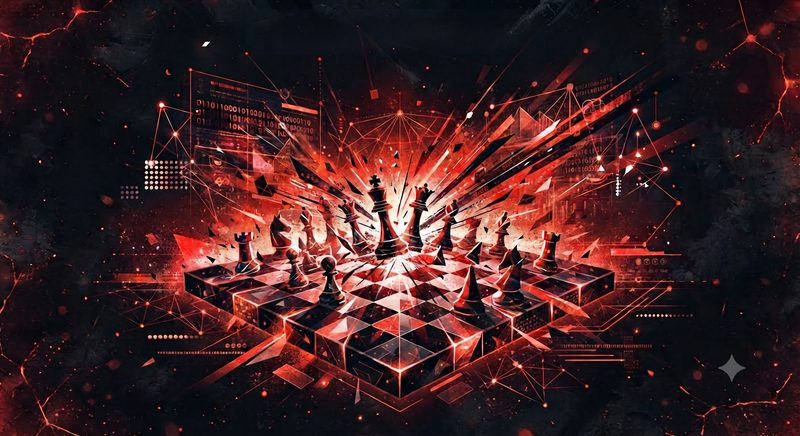
HAVANA TIMES – Have you ever wondered why a chessboard has 64 squares? Why a piece, no matter how powerful it may be, cannot escape the board?
Perhaps because chess is much more than a game. It has always seemed to me that chess is, in some way, a metaphor for life, because when we begin a game, we are already inside a world governed by rules we did not choose and from which we cannot escape.
That board can perfectly represent the society into which we are born. We all arrive at it in a particular position, under conditions we did not choose and with possibilities that are not exactly the same for everyone.
And the same is true of the chess pieces. They do not all have the same power or the same ability to move. Some have a much greater range, are better protected, and can exert enormous influence over the others, while some must advance slowly and often end up being sacrificed so that someone else can achieve a greater objective.
Pawns are the best example.
They are the majority. They are the ones out front, the ones who bear much of the battle and, on many occasions, the first to disappear. And yet Philidor said that pawns are the soul of chess. Perhaps because without them there really is no game. There is no strategy and no victory.
The pawn has very little power and, moreover, has a limitation that I find particularly significant: it cannot move backward. Once it advances, it can never go back.
And that is a lot like life. There are decisions we make, circumstances that force us to move forward, and moments when we simply have no possibility of returning to where we came from. All we can do is continue.
But the pawn also has an extraordinary possibility. If it manages to cross the entire board, it can transform. It can become a much more powerful piece.
And perhaps therein lies one of the great lessons of chess: the fact that we begin from a disadvantaged position does not necessarily mean that we have to end up the same way.
Of course, it would be naive to think that everything depends on our own will. In chess, a piece can play correctly, resist, and fulfill its role perfectly and still be sacrificed because it is part of a strategy beyond its control.
Something similar happens in life. There are people who end up paying the consequences of decisions made by others who have more power than they do. And that is something we cannot ignore when we talk about freedom.
Because then an even more interesting question arises: who moves the pieces?
The pieces are on the board, but there is someone outside it who observes the position, calculates the possibilities, and decides which move to make. The player has a power that no piece possesses, because the player knows a part of reality that the pieces themselves cannot know.
And perhaps that is why human beings have spent thousands of years asking who moves the pieces of our own existence.
Some call it God. Others call it destiny. Others believe there is some higher force or intelligence beyond our capacity to understand.
Perhaps we ourselves are pieces on a much larger board, of which we can observe only a small part.
And if we continue looking at the pieces, we can find other similarities with life.
The knight, for example, has an ability the other pieces do not possess. It can jump over obstacles. It can represent those people who, despite not being born into a privileged position, possess certain abilities that allow them to find paths different from those taken by everyone else.
The bishop has great mobility and can travel long distances, but it is condemned always to move on the same color. It can represent those who have knowledge, vision, and influence but remain constrained by the limits of the position they occupy.
The rooks better represent strength and structure: economic power, large organizations, institutions, and everything that has a sufficiently solid foundation to exert influence.
And then there is the queen, the most powerful piece on the board. It can move in virtually any direction and completely change the course of a game. It represents power, influence, sensuality, and also the fascination a woman can exert over male desire.
And finally, we have the king, perhaps the most curious piece of all. It is the most important, but it is not the most powerful. Its movement is very limited, and it needs all the other pieces to fight to protect it.
The king perfectly represents someone who occupies the pinnacle of a power structure. He appears to be above everyone else, but in reality he is an incompetent who depends on an entire system to sustain his position.
But there is something I find even more interesting.
On the board, there are always two opposing sides. Each has its pieces, its strategy, and its objectives. And each player is convinced that their way of playing is the right one.
Doesn’t something similar happen in life?
Many times, we stop seeing people and begin seeing enemies. We stop listening to those who think differently because we are convinced that we possess the truth and that the other person is wrong.
And perhaps that is where fanaticism begins.
When we stop thinking for ourselves and start behaving like pieces on a board designed by others.
Because choosing a side does not necessarily mean being free. You can switch sides and still remain on exactly the same board, obeying the same rules and moving within the limits established by someone else.
Nor can we fool ourselves into thinking that we can live completely outside the board. We are social beings, we need others, and we are part of structures that existed before we arrived.
But there is something we can preserve, even within that board: our ability to think.
And for me, that is one of the fundamental issues.
Perhaps we cannot choose the board on which we begin the game. Perhaps we cannot control every move that will occur during it. But we can still decide how we are going to play.
So, if you are a pawn, do not think you are insignificant. Having less power does not mean having no value. A pawn can cross the entire board and become something that initially seemed impossible.
Do not let anyone convince you that because you were born at the bottom, your destiny has already been written. And above all, do not let anyone think for you.
Because perhaps true freedom does not consist of escaping society—something probably none of us can do—but rather of preserving enough awareness to understand where we are, what the rules are, and to decide for ourselves how we want to play the game of life.
And perhaps true greatness does not lie solely in reaching the final row and being crowned. Maybe it lies in having managed to advance across a board that was often stacked against us without surrendering our will along the way.
As long as a pawn keeps moving forward, aware of what it is and what it wants to become, the game is not over.
I really liked this article drawing parallels between chess and life.
Cuba has the power, like a pawn, to do great things and transform.
In this chess game, Cuba was justified in revolution. And given the US and mafia exploitation, it was not unreasonable to explore Marxism. Like Sweden, they explored Marxism in the early 1900s, but being free to do so, modified their objectives to incorporate elements of capitalism and socialism and look where they are now.
If the US would stop their overt and covert operation, then Cuba could return to a fair game of chess, and within the rules, chart their own path to success for the people of Cuba.
The US Monroe/Donroe doctrine has left an ugly impact on democracy in Latin America. It is time to play by the rules again and unite to assure that we can play chess; each using their own strategy. Thanks Pedro Pablo Morejon.