
What an Injustice!
By Eduardo N. Cordovi Hernandez
HAVANA TIMES – A few days ago, I read on a Facebook post about an irregular situation in Havana’s Playa municipality that had driven an entire neighborhood block to desperation.
It involved a broken or out-of-service voltage transformer. What makes the situation so chaotic and dramatic is that, at present, the electricity service barely manages to provide about three hours of power every six hours — in other words, six hours of electricity and eighteen hours of blackout in a single day. And that’s under optimal conditions.
But in the case I’m writing about today, there would be no electricity until the broken transformer was replaced.
And here’s the kicker: There are no transformers! Apparently, they’re very difficult to repair. I don’t know… I’m starting to believe my friend Tirso, who insists that Cuba has entered the Event Horizon of a Tiny Black Hole.
I don’t know how long the people in Playa remained in that situation. Precisely because of the lack of electricity in my own area, which makes it impossible to adequately charge our cell phones. This, compounded by an inefficient, slow, expensive, or nonexistent Internet connection, I was unable to keep following the story, which continued to be updated daily, until my own objective reality made me realize that keeping informed about that case was a luxury beyond my actual means.
But I can understand their situation, because mine has been similar for the past three days. And it wasn’t even because of a broken transformer! It was something much simpler and more immediate. Even so, it would test the endurance of a fakir or a masochist.
Let me tell you:
Boom! I wake up in the morning. No electricity. They would probably turn it back on at nine. Sure enough, thank God, “Let there be light,” as the Word says. Not five minutes passed before it went out again. Since the line protector for my refrigerator is broken, I quickly ran to unplug it. Two minutes later, the power came back on. I waited a reasonable amount of time and turned on the living-room light to monitor the situation, and that’s when the story began: The light stayed on, but dimly. So dim that it would go out and then come back on. Until finally, it went out completely.
Yet I could hear music coming from my next-door neighbor’s house. That alerted me. I went out and asked her. Sure enough, she had electricity. She hadn’t noticed any low voltage either.
There had been other times when she had electricity and my house didn’t, because my house is supplied by a different transformer, so I thought that might be the reason.
My house is the first one, with a door facing the street, along an interior passageway with seven more homes behind it.
I was going to check the electric meters located at the back of my house, but I didn’t have to check anything. The neighbors immediately told me that they all had low voltage.
Someone tested the outlets with a neon tester and confirmed that electricity was reaching them. That pointed to a loose connection in the ground wire. Another indication was that the air conditioners were working; since they operate on 220 volts — that is, two 110-volt phases — they don’t need the neutral wire, also referred to as the “ground.”
Having air conditioning doesn’t do anyone much good when it’s time to make lunch, since no one has seen a full cylinder of cooking gas in months. Nor does it solve the need to pump water from the cistern up to the rooftop tank.
Someone might say: “Well! At least you have water in the cistern!” Which almost makes you sound ungrateful or unreasonably demanding. The reality is that, in the middle of the 21st century, even if someone is young, healthy, and reasonably intelligent, hauling buckets of water out of a cistern to flush the toilet, bathe, cook, wash dishes, and so on requires such an enormous effort and creates so many inconveniences inside a home that it can be difficult to comprehend. Much more so if you’re already over sixty.
Today marked three days.
Ten in the morning, two blocks from my house. I’m waiting for the ration store to open. Then I notice a vehicle from the Electric Company stopped nearby. A young woman is talking to the workers. I approach to ask whether they had come to fix the problem affecting us. I wait politely about five feet away. I manage to hear the driver say, in a somewhat authoritative and categorical tone: “We don’t do favors. That was in the past.” The young woman walks away visibly furious.
Finally, I ask, and he tells me: “You have to call… We only respond to orders from the Company. If you’ve already called, you must wait.”
A few yards farther down the road, the same young woman stops them again. They backed up one block and started working. Twenty minutes later, they were honking their horn in front of my house. They were asking for the person who had filed the service request.
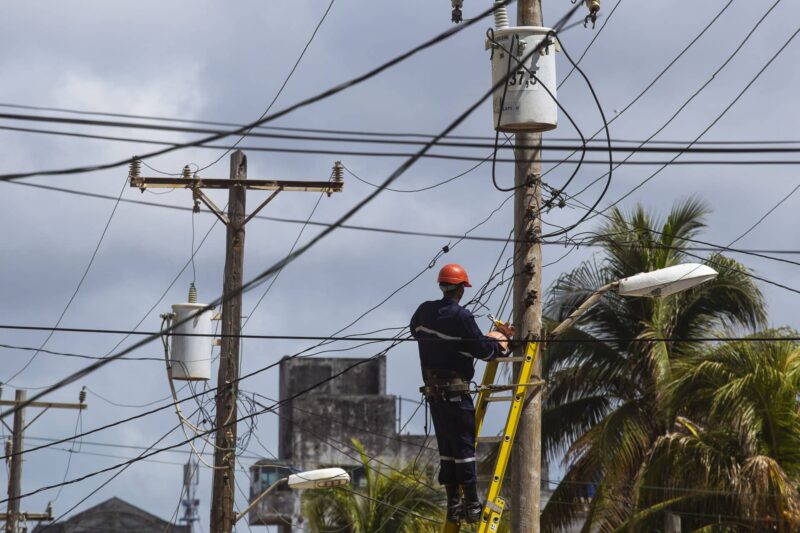
It’s because of all these things that — when you get tired of calling the municipal office of the Electric Company to get someone to come and do the work, spending hours listening to the phone ring without anyone answering, and then they take three days to show up and make a repair that consists of nothing more than putting up a ladder and twisting together two wires that aren’t even live — you just don’t quite understand.
What I didn’t understand was why, before leaving, they asked, with a somewhat irritated and demanding tone, whether there “wasn’t something” for them.
What an injustice!
Read more from the diary of Eduardo N. Cordovi aquí en Havana Times.