
Doral, Florida Is Deserted: Venezuelans Face ICE Operations
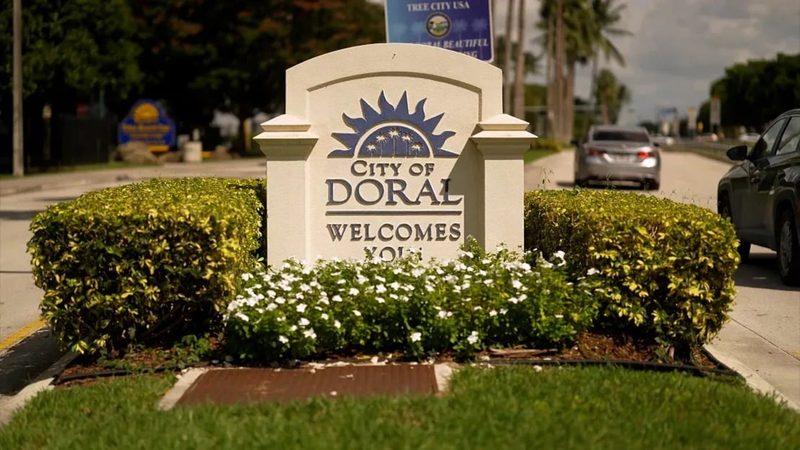
Mothers organize support networks through neighborhood chats to get children and teenagers to and from school.
By Albany Andara Meza (Efecto Cocuyo)
HAVANA TIMES – The front door of the apartment shuts with a click, and Julián Sanabria* quietly thanks heaven as he locks it. He is grateful to have returned safely from work, not to have come face-to-face with any agent from US Immigration and Customs Enforcement (ICE), and to have made it through another day in Doral, which has now become a silent city in Florida’s Miami-Dade County, where migrants are afraid even to look out their windows.
“Little Venezuela,” as several US media outlets, including the Los Angeles Times, have called it, is going through some of its most critical days following the increase in enforcement operations and deportations. Sanabria is convinced that making it home without being arrested is a stroke of luck that could run out at any moment.
“How did we go overnight from being a community to living with this fear and feeling as though we were doing something wrong? I stopped going out, like many others. The city is deserted, and we definitely don’t deserve this. I stopped going to the gym in my free time, stopped going out to dinner, stopped going to the supermarket. The only reason I leave my house is to go to work, and that’s because fortunately I have some friends who pick me up and bring me home afterward. I’m not using my car because of license-plate scanning, which is the main reason they’re stopping people and asking for their papers,” Sanabria tells Efecto Cocuyo in a WhatsApp call.
The detention of migrants in the United States has increased dramatically in recent weeks. On August 15, 2026, the Department of Homeland Security announced that migrants whose TPS (Temporary Protected Status) had expired must leave the country immediately or face deportation.
Residents report raids that directly affect Venezuelan citizens, many of whom have pending applications or are in the process of resolving their immigration status. The operations have completely altered the social and economic dynamics of Doral, considered the epicenter of the Venezuelan diaspora in the United States.
It is 7 p.m. on September 10, and Julian is managing his anxiety as best he can. In a few minutes, he will turn on his laptop and work through the night in an attempt to distract himself. When he moved from Venezuela to the United States in December 2014, Sanabria thought he would never again feel persecuted or threatened, because that country to the north promised to be “The Land of the Free.” He recalls deciding to migrate after the young Robert Redman was shot in the head while exercising his right to protest in Chacao, Caracas, on February 12 of that year, during demonstrations against the government of Nicolas Maduro.
“I’m an advertising professional, and at the same time I worked in politics. I was a national youth representative for the Un Nuevo Tiempo party, I was active in La Guaira, and I also worked for Rumba Caracas, a media outlet that covered nightlife. I left the country because the situation was extremely serious. Going out to cover a story or attend events was very difficult because crime was at its peak. Venezuela was definitely no longer a country where I could develop professionally. I received many threats from different people in the government, especially local officials in Vargas. When Robert Redman died in Caracas, several young people organized a protest in La Guaira, and that was the situation that ultimately triggered my departure from the country,” Julian recounts.
He says that during the demonstration he was chased and threatened by armed pro-government groups after nightfall in Macuto. He was also harassed by the La Guaira police. At the end of 2014, he packed his belongings and traveled to the United States with his boyfriend, and together they paid for English classes. Over the following decade, he applied for asylum, opened a small agency, settled in Doral, got married, acted in two successful Nickelodeon programs, worked at Telemundo, and had a small role in Simón, a film that dealt with Venezuela’s sociopolitical situation and the migrant experience. His asylum case took a total of 10 years to be addressed, and in 2025 he received an appointment for his first interview.
On September 4, the US Board of Immigration Appeals determined that Nicolas Maduro’s removal from power on January 3 constitutes a significant change in conditions in Venezuela. For this reason, immigration judges are required to reevaluate asylum applications under this new political scenario. However, this does not mean that Venezuelan migrants’ right to seek international protection has automatically been revoked.
“I can’t go back to Venezuela. My passport was revoked just after I worked on the film Simón. After the 2024 elections, during the so-called Operation Tun Tun, they sent a summons that arrived at my family’s home. On top of all this, the people who threatened me still hold positions of power in Venezuela. Maduro was taken away, but the other institutions and politicians haven’t changed,” Julian says of his case.
Businesses Close
The Pew Research Center estimated that 1.2 million people from Venezuela were living in the United States in 2024. Doral has around 84,000 residents, 40% of whom are of Venezuelan origin. For years, this community has been the predominant Hispanic group in the city, according to state records.
“How can you give me a letter saying I’m authorized to remain in the United States, give me a work permit, give me a Social Security number, and then tell me I’m illegal? I pay taxes, I have a bank account, I work legally in this country, but suddenly someone comes along and wants to detain me like a criminal,” Sanabria emphasizes.
The city government has faced strong criticism over its decisions and its cooperation with the immigration policies of President Donald Trump’s administration. In April 2025, the Doral City Council unanimously approved signing a 287(g) agreement, a cooperation arrangement between ICE and local law enforcement agencies designed to allow municipal authorities to assist in identifying and processing people with irregular immigration status.
“About three weeks ago I had been working exclusively from home and was going crazy. I said, ‘I have to get out immediately,’ so I headed to the gym, which is ten minutes from my house. On the way, I came across an ICE checkpoint. It was horrible. I turned around however I could and went back home. I felt such a horrible sense of helplessness and injustice that I couldn’t stop crying. I was gripping the steering wheel. Not even in Venezuela did I feel as hunted as I have felt during the past few months in this country. It’s very humiliating. And local authorities can’t simply pretend everything is fine. We have a mayor here who publicly emphasizes her constant support for the current US administration, even though her community is Latino and Hispanic,” Sanabria says.
Recently, Doral Vice Mayor Rafael Pineyro said that business losses in the city range from 40% to 60%. Dozens of Venezuelan-run businesses are permanently closing their doors, and some owners are saying goodbye to their customers on social media. One example is Shawarma Grill, located near 84th Street and 70th Avenue. On September 9, Pineyro reported that he had sent letters to members of Congress and other officials outlining the city’s current problems.
“It hurts to find out that places I used to visit are no longer open. It’s very difficult because we had already made this city our home, and now it feels as though we shouldn’t be here. A lot of people built their businesses through hard work, and now all of that is ending in the blink of an eye. It’s very unfair; we’re not hurting anyone. I already have six friends—two couples among them with children—who preferred to pack their belongings into a suitcase and leave. I have one friend who pulled down the shutters, so to speak, and went to Europe,” Sabrina Oropeza* tells Efecto Cocuyo.
Mothers Organize
On September 11, Doral Mayor Christi Fraga said in an interview with Carla Angola that local police neither participate in nor direct ICE raids—despite the 287(g) agreement—and that she learns about them “at the same time” as residents. She also warned that these operations are having a major social impact, as families are avoiding taking their children to school out of fear. In some cases, they even resort to private Uber transportation.
Some mothers have organized support networks through neighborhood chats to get children and teenagers to school. Trusted neighbors and friends who are US citizens or permanent residents take turns driving groups of underage students to class so that their families can avoid the risk of arrest.
In early September, the Department of Homeland Security (DHS) announced that it had broken a record for the number of migrant detentions in August. According to ICE figures, 50,925 people were arrested last month, surpassing the 49,571 arrested in July. Meanwhile, Venezuelans are shutting themselves inside their homes. Several families are trying to obtain the help of immigration attorneys.
In Doral, the streets have gradually emptied as the community sinks deeper into uncertainty.
“Now Doral authorities are constantly posting Instagram videos saying they’re sending letters and doing things, prayers here and prayers there. That does us no good. We need them to take action like other cities have, starting by canceling that agreement with ICE that is hurting us so much,” Sanabria demands from a Doral that is slowly going dark.
*The names of those interviewed have been changed for their safety.
First published in Spanish by Efecto Cocuyo and translated and posted in English by Havana Times.
Totally false!
If you’re here in the United States legally and have broken no laws, then there’s nothing to fear.