
In Cuba, the Street Is the Red Line
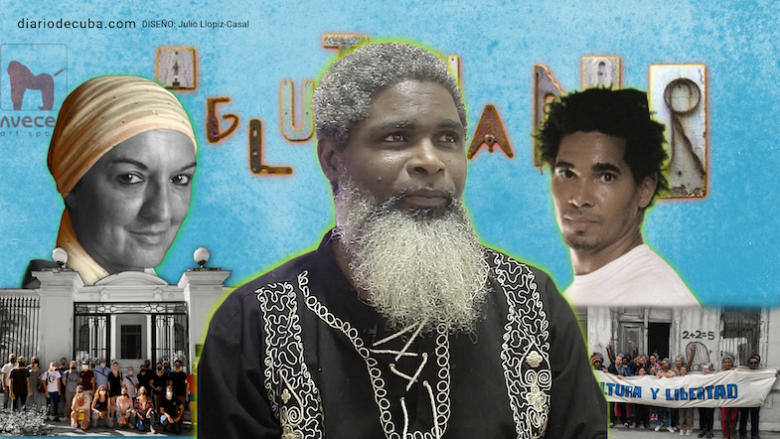
Taking art out of galleries controlled by state institutions to break the State’s monopoly: Part Eight of an investigative series by journalist Marianela Balbi.
By Marianela Balbi (Diario de Cuba)
HAVANA TIMES – The harshness of the so-called Special Period—the campaign of enforced stoicism that the Cuban regime imposed on the population following the collapse of the Soviet Union and the loss of its economic support in the early 1990s—did not prevent Amaury Pacheco from seeing the glass as half full. He believed that those extreme hardships, which forced ordinary Cubans into unspeakable sacrifices, might also weaken the regime’s authoritarian grip, diminished by the crisis. It was the moment, he thought, to create grassroots projects that would recover the human values the Revolution had lost, rather than prepare for exile.
Resist through “purity”? He still believed it was possible.
Amaury Pacheco was—and remains—a self-taught popular poet, a man of the people and of the streets, from the Alamar housing project, an area that serves as a repository of Soviet brutalist relics. During those years of deprivation, he saw an opportunity to genuinely embrace the original values of “humanity” that Castroism preached but failed to practice, through the development of “an art that should not be locked away in galleries for an elite; it should exist in the streets, inspired by Afro-Cuban traditions and everyday usefulness,” he says from Oklahoma, where he now lives with his wife, theater actress, activist, and performance artist Iris Ruiz after being forced to leave Cuba.
“Omni Zona Franca was a space that used art as a language to dismantle official circuits (…) where performance and meditation served to cleanse the body, strip away the corporate body, and confront the symbolic discourse designed by the State to control us,” he explains in an interview for this story.
“Art is a tool for citizens, a spiritual tool. We organized festivals, such as Poesía sin fin (‘Endless Poetry’),” Pacheco recalls, “which sought to address both the spiritual and material needs of neighborhoods by using joy as a force to transform reality and awaken civic consciousness (…) Art in public space is not merely aesthetic; it is a civic exercise aimed at transforming the individual’s perception of political reality.”
Artist Yasser Castellanos remembers that hip-hop festivals pursued a similar goal. Castellanos remains in Cuba under the status of a regulado—prohibited from leaving the country—because he was among those who barricaded themselves with Luis Manuel Otero Alcántara during the San Isidro Movement protests. He closely links that experience to his visual art.
“The first time I created a visual work with my own personal stamp was under the influence of Cuban hip-hop, after seeing the rap festivals of 1995 and 1996.”
He too became involved with Omni Zona Franca, writing lyrics for musical performances, poetry meant to be sung, and designing sets for street events. “But the government took over the festivals and stole them from their founders.”
Amaury Pacheco gives the State a proper name: The Beast.
“The Beast arrives. The State monitors festivals and allows them to grow only so it can identify who participates and where the support comes from, before launching a televised smear campaign aimed at the artist’s moral assassination.”
Their main objective was never to seize political power, Pacheco and Ruiz acknowledge from exile in Oklahoma.
“We wanted to push the boundaries of what was permitted by planting a seed of spiritual insurrection in people. We wanted to learn how to become citizens. I followed a path that transformed me from a poet into a citizen, and art allowed me to understand the regime’s deceptions and recover my individual sovereignty, moving from the intellectual to the operational.”
Drawing on her experience as an actress, Iris Ruiz is convinced that the body itself is a space for debate.
“We put our bodies into public space. It is not enough to philosophize; freedom is exercised through concrete civic acts that challenge fear.”
Husband and wife shared the goal of taking art out of galleries controlled by state institutions in order to break the State’s monopoly over public space and public discourse. But this automatically branded them as “counterrevolutionaries” in the eyes of the regime.
In 2016, after 15 years of organizing poetry festivals, Omni Zona Franca was dismantled, and nearly all of its members went into exile.
Yet art would soon sprout again as an act of rebellion.
It happened in Havana’s San Isidro neighborhood in 2018. When Omni Zona Franca’s members saw what was beginning to emerge in the streets, they applied their experience to what activists started calling “operational interventions.” Art became useful because, once placed in public space, it was visible to everyone, exposing before the public’s eyes the symbolic structures the regime uses to legitimize itself.
“These actions became exercises in citizenship. It wasn’t just about winning a legal battle; it was about showing people that it was possible to challenge an unjust law, such as Decree 349. By turning the neighborhood into the stage for debating a law, the San Isidro Movement enabled ordinary Cubans to connect with the artist’s struggle against State control,” Amaury Pacheco explains.
Omni Zona Franca belongs to a genealogy of resistance that also produced branches such as Tania Bruguera‘s Cátedra de Conducta (Behavior Art School), Archipiélago (#YoTambiénExijo), and the San Isidro Movement.
Omni Zona Franca pushed the boundaries of what was permitted through festivals and street art. Tania Bruguera, through her ideas and her students, introduced an ethical and political dimension to committed art emerging within official institutions, shifting the focus from aesthetics alone to the artist’s conduct as a citizen. Finally, the San Isidro Movement demonstrated the operational maturity necessary for raising awareness and mobilizing people.
As Amaury Pacheco summarizes it, “The San Isidro Movement represents the culmination of these previous experiences, combining the technical precision of Omni Zona Franca with a more confrontational activism.”
Decree 349 Sparks an Artistic Wildfire
In December 2018, the glass towers where a new generation of artists had been working suddenly found themselves within reach of the discontent of ordinary people who never set foot in galleries or museums.
That was when Decree 349 came into force, one of the first laws signed by Miguel Díaz-Canel after assuming Cuba’s presidency—though not actual power, which remained in the hands of Raul Castro.
Alarm bells had been ringing since April of that year, when the new administrator of the dictatorship enacted the measure, formally granting the State authority to intervene in any creative activity.
Under the decree, musicians and performers could no longer appear in either public or private venues without prior authorization from the authorities. Anyone hiring them risked confiscation of property and heavy fines, with no possibility of appealing decisions based not on clear legal standards but on official discretion.
The same rules applied to exhibitions, manuscripts, and every other form of artistic expression.
What disturbed artists most, however, were the restrictions placed on creative content, including bans on audiovisual works containing “the use of national symbols contrary to current legislation,” “sexist, vulgar, or obscene language,” or “any other content that violates the legal provisions governing the normal development of our society in cultural matters.”
To further humiliate the independent artists’ collectives then flourishing in an underground world beyond the reach of official galleries, state funding, and government curators, Decree 349 effectively abolished those autonomous spaces.
Many of those microhabitats of freedom resembled Espacio Aglutinador, created in 1994 by multidisciplinary artist and curator Sandra Ceballos with an exhibition entitled Degenerate Art in the Age of the Market.
That gesture earned her another form of ostracism.
“For exactly 29 years my work has not been exhibited in Cuba. Why? Because I opened a nonprofit private gallery in my home and studio with democratic proposals. By creating this place—a space of freedom completely independent from the Cuban State—my work was banned in Cuba beginning in 1998. Very few art critics or curators in Cuba dare exhibit my personal work for fear of reprisals. Throughout all these years I have stoically endured living somewhere between internal exile and exile abroad. I continue working on my own artistic practice,” Ceballos says from Havana.
Espacio Aglutinador closed in 2021—she says for personal reasons—and since then she has transformed it into an online international gallery on Instagram, where she works as a curator and invites others to collaborate.
Art curator and critic Solveig Font also established an independent space in her home in 2014 before emigrating to Spain.
It was called Sometimes Art Space, a name reflecting the fact that it was only “sometimes” a venue for artists. There was no formal schedule.
“We didn’t want pressure. We wanted to do something whenever we wanted, with whomever we wanted, whenever we felt like it,” she told journalist Amilkar Feria Flores for the website Alas Tensas.
Sometimes Art Space was likewise condemned to extinction by Decree 349. Private spaces now also fell under State control.
Speaking from Spain, Font recalls that “a certain degree of freedom was allowed in private or semi-private spaces, such as parties, or through irony in artworks, provided certain political limits were not crossed. It was a very carefully calculated permissiveness, designed to give hope and then frustrate it, keeping artists within the system.”
The San Isidro Movement crossed those limits.
The crackdown on artists and creators came swiftly. At the center of the regime’s target stood the San Isidro Movement and its most recognizable figure, Luis Manuel Otero Alcántara.
He was already known for his 2011 sculpture series about Cuba’s Angola war veterans, Heroes Are Not Heavy, and had become a leading figure among artists openly opposed to the regime with an independent political voice.
He had also organized the #00 Havana Biennial, the first independent biennial, placing him squarely on the regime’s radar.
Protests erupted, followed by the harshest repression. In November 2020, authorities arrested artists along with popular musicians, including rappers Denis Solís and Maykel Osorbo.
To resist State Security forces, members of the San Isidro Movement barricaded themselves inside Otero Alcántara’s home at 955 Damas Street and began a hunger strike demanding the release of those recently imprisoned.
Six days later, State Security agents, accompanied by thugs disguised as doctors, stormed the house and forcibly evicted everyone, recalls Yasser Castellanos, one of those inside. The operation was justified under the pretext of COVID-19 health measures.
The struggle now centered on repealing Decree 349 and securing freedom for prisoners of conscience.
On November 27, 2020, between 300 and 500 artists, intellectuals, and filmmakers gathered outside Cuba’s Ministry of Culture in Havana, demanding freedom of expression, an end to the harassment of independent artists, and an end to treating dissent as a crime.
A delegation of 32 people was received by government officials, and that action gave birth to the 27N Movement.
At the forefront stood figures such as Tania Bruguera.
It was difficult to ignore someone of Bruguera’s international stature, capable of rallying solidarity worldwide, or Coco Fusco in New York, who still has an open government case against her for participating in the #00 Biennial and has since been barred from entering Cuba.
Many artists who still lived in Cuba also attended, including Reyner Leyva Novo.
These were prominent figures who met with Deputy Minister of Culture Fernando Rojas, who initially appeared willing to engage in dialogue.
That willingness collapsed almost as soon as they walked out the Ministry’s doors.
The status quo of coexistence and carefully calibrated tolerance that had seemed to exist between artists and the State for more than two decades broke down under Miguel Diaz-Canel.
His government now faced growing international scrutiny, with observers beginning to question its supposedly soft policy of “letting artists do as they pleased”—a policy the regime had proudly cited as proof that the Cuban Revolution nurtured its creators and exported the finest achievements of Cuban visual arts.
Until it felt compelled to resort to harsher methods.
“Patria y Vida” (“Homeland and Life”) became the slogan of the popular demonstrations, and the song of the same name became their anthem—as well as an international hit.
Activists went door to door explaining to neighborhood residents why Decree 349 affected them directly. The police, they explained, could now shut down a concert on their own block.
They demanded freedom of expression and the right to dissent.
They demanded the right to have rights, political freedoms, economic freedoms, and the right to a better life.
For Amaury Pacheco, activism had reached the level of maturity he had envisioned since the days of Omni Zona Franca.
The neighborhood had become a stage for political debate, allowing ordinary Cubans to see themselves reflected in the artist’s struggle against State control.
Independent journalists, lawyers, and curators joined the effort.
Networks were established to document arrests and report them to international forums such as the United Nations.
Everyone had become citizens, and organization had become everything.
Divide and Conquer
In an effort to sow division among the movements—to separate the wheat from the chaff by distinguishing between “good” and “bad” artists, between artists and mere activists, between graduates of the Higher Institute of Art (ISA) or San Alejandro Academy and self-taught creators from Alamar and San Isidro, between Whites and Blacks—the regime activated mechanisms designed to discredit the insurgents and deal a fatal blow to the protests.
Yasser Castellanos was labeled a counterrevolutionary “for declaring myself an independent artist, a cimarrón,” he wrote on Facebook.
He was barred from leaving Cuba as a regulado and was arrested in 2021.
“In December 2020 I was standing in one of those endless lines so common in Cuba when I heard a young man, about twenty years old, say that the people from 27N were ‘the smart ones’ while those from the San Isidro Movement were ‘the dumb ones.’ The young man was just as mixed-race as the activists he was insulting. He was repeating precisely the image the government wanted to promote about the San Isidro Movement. They tried to make its most visible members as unpopular as possible, among other things by subtly—or sometimes crudely—stoking racial prejudices that had never disappeared simply because they had been officially outlawed.”
The protests between 2018 and 2020 brought deep-rooted prejudices such as racism and classism back to the surface. They had seemed eradicated, but in reality they had merely been shelved, lying dormant.
All it took was for Castroism to stage a symbolic boxing match in the San Isidro neighborhood, placing actor Jorge Perugorría in one corner and Luis Manuel Otero in the other.
The State energetically manipulated its symbolic machinery to highlight the differences and inequalities between the celebrated actor—the Mario Conde of Leonardo Padura’s novels, the Revolution’s prized cultural trophy—and, on the other side, the cimarrón who stripped naked, wrapped the Cuban flag around his waist, went on hunger and thirst strikes, and nevertheless sold his works to major museums and international collectors.
Solveig Font clearly recognized the rules of this contest.
“It illustrated the discriminatory treatment within Cuba’s cultural system based on proximity to power and social origin. While Jorge Perugorría, through his son, established the Galeria Taller Gorria project just one block away from the headquarters of the San Isidro Movement—with every possible resource to do whatever he wanted—Luis Manuel Otero has never been given anything.”
Font also remembers the outrage many felt when, during the November 27 meeting with Deputy Minister Fernando Rojas, Jorge Perugorria appeared wearing a T-shirt reading “I ♥ San Isidro.”
“He gave a disappointing speech, especially because everyone knew he enjoyed privileges while his neighbors were being repressed,” Font recalls.
In contrast, Luis Manuel Otero Alcantara was portrayed as an artist “without formal training” and of humble origins. State Security described him as a “liar” and “shameless.”
Yet when the State promoted other artists from working-class backgrounds, it celebrated them as examples of Cuba’s ability to provide social mobility and international success.
“There is a different treatment of Luis Manuel Otero Alcántara because he is a marginalized Black man. The State accepts Blackness as long as it is docile, but in Luis Manuel it sees a Cuba in decline that the government prefers to conceal behind its propaganda of elite education and culture,” Solveig Font says.
Without embracing the State’s censorious perspective, artist Jose Bedia nevertheless expresses reservations about the San Isidro Movement’s activism.
“I know that Cuban society has little motivation for making the kind of break represented by the San Isidro Movement and the protests against Decree 349. But there are things that simply don’t interest me as an artist. I believe an artist should paint, make sculpture, and work. I’m not an activist, nor do I think an artist can be an activist: you’re either an activist or an artist. I think the artist’s voice is very modest and limited; doing one’s work well is enough. I don’t believe an artist has any other duty. The San Isidro Movement was courageous, but artistically it falls short. They have the drive to change political realities, but the artistic side suffers. Besides, there’s a kind of martyrdom to it that leads nowhere—they’re just taking the blows.”