
The Conversation Between Torrijos and Carter in Sept. 1977
One day before the Treaties were signed
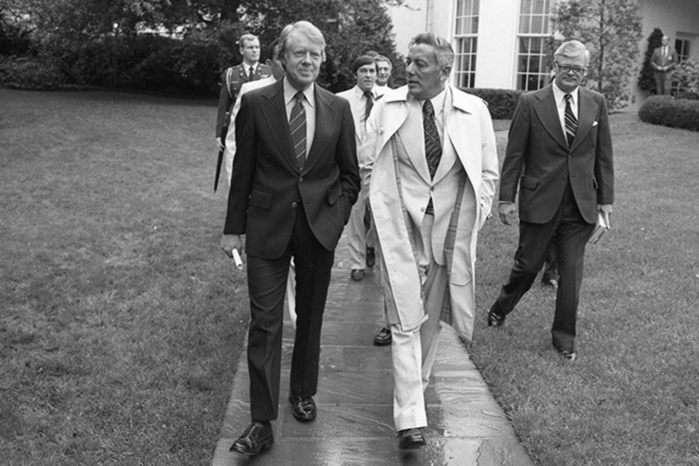
Declassified documents reveal what Torrijos and Carter discussed on the eve of one of the most consequential agreements in Panama’s history.
By Adriana Berna (La Estrella de Panamá)
HAVANA TIMES – There was just one day to go before Panama and the United States would sign the agreements that would forever transform relations between the two countries. Inside the White House, Jimmy Carter and Omar Torrijos held a meeting that, viewed from a historical perspective, is almost as revealing as the ceremony that took place the following day.
According to records in the U.S. Department of State’s Foreign Relations of the United States, the meeting began at 11:10 a.m. in the Cabinet Room of the White House.
Torrijos arrived accompanied by members of his team, including Foreign Minister Aquilino Boyd, Minister of Planning and Economic Policy Nicolás Ardito Barletta, Ambassador Gabriel Lewis Galindo, and Lieutenant Colonels Manuel Antonio Noriega and Roberto Díaz Herrera.
On the U.S. side, in addition to Carter, participants included Vice President Walter Mondale, Secretary of State Cyrus Vance, National Security Adviser Zbigniew Brzezinski, Assistant Secretary of State Terence Todman, Ambassador William J. Jorden, and Robert Pastor of the National Security Council.
The meeting was not merely a diplomatic formality. The treaty still had significant hurdles to overcome. In Panama, Torrijos faced a plebiscite and had to convince a population that had made the recovery of sovereignty over the Canal Zone a national cause. In the United States, Carter needed to persuade a Senate where considerable opposition to the agreement still existed, notes scholar and diplomat Omar Jaén Suárez in The Negotiations of the Torrijos-Carter Treaties: 1970-1979.
Carter began by asking Torrijos what he believed the chances were that the treaty would succeed. The Panamanian head of government’s response showed that, as far as he was concerned, the battle had not yet been won. Torrijos explained that he would travel throughout Panama to personally defend the agreement.
According to the U.S. memorandum, he would do so “by helicopter, horseback and on foot.” He estimated that around 900,000 people would vote out of a population of approximately 1.7 million. He also emphasized a symbolic factor: many 18-year-olds would be voting for the first time. For Torrijos, achieving high voter turnout was essential.
‘We Are Selling the Same Product’
During the conversation, Torrijos used a particularly vivid comparison to describe the political situation facing both governments. He told Carter that Panama and the United States were “selling the same product,” but in two different markets, according to the State Department’s historical records.
The comparison summed up one of the central problems of the negotiations. The agreement could be presented as a reasonable solution for both sides, but it needed to be defended with different arguments in Panama and the United States.
For Torrijos, it meant ending a system that Panamanians regarded as incompatible with their sovereignty. For Carter, it meant convincing Americans that relinquishing the control Washington had exercised over the Canal for decades did not constitute a strategic defeat.
Torrijos had to convince the Panamanian people, and Carter the U.S. Senate. Omar Torrijos Foundation
Torrijos Admits He Never Expected to Reach the Finish Line
One of the most revealing moments in the conversation came when Torrijos spoke candidly about his expectations. The general acknowledged that he had never believed the two countries would manage to reach a final treaty. In his view, for years the negotiations had circled around the problem without truly addressing the fundamental issues.
Torrijos recalled that citizens of his country found it incomprehensible that U.S. police officers could arrest young Panamanians inside the Canal Zone. For him, such situations represented the everyday manifestation of a sovereignty dispute that had fueled conflict for decades.
The Panamanian leader credited Carter with changing the US attitude toward the Canal issue. He told the new US president that he had introduced a different philosophy and described his decision to confront the issue through negotiations as an “act of courage.” He also acknowledged that, before his visit, he had not fully understood the depth of the political difficulties Carter faced within the United States.
Jaén Suárez documents how the negotiations were shaped by decades of conflict and by the political importance in Panama of recovering sovereignty over the Canal Zone. The process spanned several US administrations before reaching the Carter administration.
When ‘Perpetuity’ Got an Expiration Date
Torrijos also referred to one of the most symbolically important aspects of the new agreement.
According to the US memorandum, he said that “perpetuity” now had an end date. What for decades had appeared permanent would now come to an end at a specific point in time.
The 1903 Isthmian Canal Convention had granted the United States rights over a strip of territory for the construction, maintenance, and operation of the Canal. The new agreement, by contrast, established a transition process that would culminate in the transfer of the Canal’s administration to Panama on December 31, 1999.
The word “perpetuity,” therefore, carried enormous political weight. For decades, it had symbolized the permanence of US rights over the Canal Zone. In 1977, Torrijos could speak of a specific date when that arrangement would end.
Carter Also Had a Great Deal to Lose
On the other side of the table, Carter was hardly in a comfortable position either. The president needed the US Senate to approve the treaties. At the September 6th meeting, he recalled that the previous year around 40 senators had signed a resolution opposing the agreement. By then, however, a new assessment indicated that only about four remained firmly opposed.
The figure shows the extent to which the Carter administration had worked to change perceptions of the treaty in Washington.
The situation, however, would remain complicated. William J. Jorden, who had served as US ambassador to Panama and participated directly in the process, later described the negotiations in Panama Odyssey as a long and deeply contentious process.
Opposition did not disappear after the signing either. In October 1977, Carter noted that correspondence arriving at the White House was running approximately ten to one against the treaties and that opinion polls showed the majority of the public opposed them.
Carter wrote in the margin of the document that he wanted to reduce the prominence of his own role and highlight the other Latin American heads of state attending the ceremony. His intention was for US television viewers to be able to identify the leaders of the continent.
The detail shows that the ceremony had also been conceived as an act of hemispheric diplomacy. Washington sought to demonstrate that the agreement with Panama could become a new chapter in its relations with Latin America.
A Rod Carew Bat and a Photograph of Panama
The September 6 meeting also ended with some much less solemn details. Carter gave Torrijos copies of his book Why Not the Best? and a volume of photographs taken from space, including an image of Panama.
Mondale, meanwhile, gave him a baseball bat autographed by Panamanian player Rod Carew, then with the Minnesota Twins. The vice president joked that by giving him a bat, the United States no longer needed to carry “a big stick.”
The exchange is striking because it occurred in the midst of one of the most important diplomatic negotiations in the continent’s modern history.
But it also illustrates the effort by both governments to build a different personal and political relationship after decades of tension.
The Signing Was Not the End
The following day, September 7, 1977, Carter and Torrijos signed the treaties at the headquarters of the Organization of American States (OAS) in Washington.
The agreements still had to be submitted to a plebiscite in Panama and subsequently undergo the US Senate ratification process. In Panama, the plebiscite was held on October 23, 1977. In the United States, the Senate approved the Neutrality Treaty on March 16, 1978, and the Panama Canal Treaty on April 18 of that year.
The treaties entered into force on October 1, 1979, but the final transfer of the Canal would not take place until December 31, 1999.
Even after the signing, discussions continued over how the agreements should be interpreted. In November 1977, Carter wrote to Torrijos to confirm that a joint declaration issued after the signing should be regarded as the authoritative interpretation of certain provisions of the Neutrality Treaty.
The September 6 conversation therefore offers a glimpse behind one of the most famous photographs in Panamanian history.
First published in Spanish by La Estrella de Panamá and translated and posted in English by Havana Times.