
OAS Secretary General: “We Have a Political Disaster in Nicaragua”
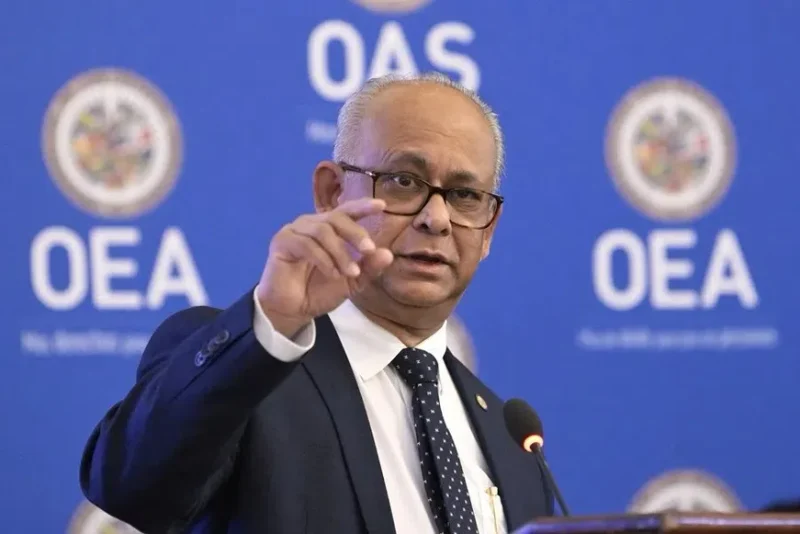
In an interview with CONFIDENCIAL, Albert Ramdin calls on governments to increase pressure and impose sanctions on the Ortega-Murillo regime.
HAVANA TIMES – Albert Ramdin, Secretary General of the Organization of American States (OAS), urged governments across the hemisphere to “take action” and put forward “concrete proposals” to increase coordinated political and diplomatic pressure on the regime of Daniel Ortega and Rosario Murillo. He described the situation in Nicaragua as a “political disaster.”
In an exclusive interview with Esta Semana, broadcast on CONFIDENCIAL’s YouTube channel because of television censorship in Nicaragua, Ramdin expressed concern that the constitutional reform promoted by the dictatorship is aimed at completely dismantling the opposition’s ability to participate in the country’s political life.
“We expect that ministers, apart from the symbolism, can make decisions individually and collectively to punish, to put more pressure on Nicaragua,” the OAS Secretary General said.
In the interview, Ramdin addressed expectations surrounding the upcoming meeting of foreign ministers on the situation in Nicaragua, which he hopes will help “create a better environment, to release political prisoners, to respect the human rights of people, but also increase the civic space for freedom of expression, civil society organizations, and political parties.”
The OAS has proposed holding a meeting of foreign ministers on Thursday, September 17, 2026, to collectively address the situation in Nicaragua, following Ortega’s declaration that there “will be no” elections in the country.
“For us, it’s important that the whole hemispheric community, the foreign ministers, everybody rejects this notion that a government, doubtfully elected, can determine what the rights of the people are,” Ramdin warned.
OAS Secretary General, thank you for this interview. After effectively eliminating elections for more than a decade, Daniel Ortega has now officially announced that there will be no more democratic elections in Nicaragua, a move that will also be enshrined in the country’s Constitution. What does this announcement mean for the OAS foreign ministers?
Well, first of all, I think no government, no president, has a right to take away the rights, the fundamental, basic rights of any citizen in any country in the sense of taking away the right to vote in terms of elections, national elections, because it is the population that chooses a president. So the president doesn’t have a right to do that. So it is something which, a statement which we must reject, must condemn in the strongest words, but at the same time, we must also act, because we have to stand with the people of Nicaragua.
The people of Nicaragua are part of this hemisphere. They are citizens of this hemisphere, and our tradition, our ambition, is to have representative democracy in every single country. Nicaragua is no exception to that.
So, independent of whether Nicaragua is a member of the OAS, they are still a part of this western hemisphere. For us, it’s important that the whole hemispheric community, the foreign ministers, everybody rejects this notion that a government, doubtfully elected, can determine what the rights of the people are. The rights of the people are given, are granted, and they should be respected.
Twenty-nine countries approved a meeting of foreign ministers to address the situation in Nicaragua in the coming weeks. Brazil opposed the meeting, while Mexico abstained. What can we expect from this summit? Does the OAS have mechanisms to implement collective decisions, or are actions taken individually by member states ultimately more effective?
When foreign ministers of the hemisphere come together in a special conference of ministers, then it’s for a good reason, an urgent reason. Member states who have not supported the holding of this meeting, the convening of this meeting, do that because of their own reason. But they are not against the principle of the rights of the people to choose their own government.
So, for me, what is more important is, what do we do now when the foreign ministers meet? The OAS is an organization based on consensus, and sometimes it goes to a vote. This was a vote, so a decision is taken, and there is respect for the decision taken in the majority.
Well, what do we expect from the ministers meeting together here in Washington DC at some point in the near future? First of all, it’s a symbolic moment, a very important symbolic signal that the hemisphere stands together, and that we can meet to discuss multilateral important issues. And this is, in many ways, not a national issue, it’s a multilateral issue, it’s a regional issue.
So, for whatever reasons there will be, we expect that ministers, apart from the symbolism, can make decisions individually and collectively, to punish, to put more pressure on Nicaragua, to create a better environment, to release political prisoners in the first place, political opposition, journalists, to respect the human rights of people, but also increase the civic space for freedom of expression, civil society organizations, political parties.
Most of these people have left the country or have been put in jail. That is not the way to organize a society that is supposed to be democratic. So, this meeting in Washington DC will be symbolically very important, politically very relevant, and has the opportunity to agree on a set of concrete measures on how to put more pressure and to open up discussion with Nicaragua.
A few moments ago, you mentioned the Nicaraguan opposition. Does the OAS recognize the role of Nicaragua’s democratic civic opposition? How can the opposition operate inside Nicaragua when the country is effectively under a police state?
Well, that’s one of the issues I raised, is that the civic space for dialogue, for freedom of expression, for expressing political opinions, should increase, whether that is journalists, whether that is civil society organizations, or political parties, or political actors. That civic space we are promoting to be increased. We are speaking with opposition leaders who are living in Washington DC.
We are listening also to their views, but it is not up to us to legitimize them. It is up to the Nicaraguan people to legitimize them, but they need to get the space. They need to get the opportunity to present their view. It is the people, ultimately, who will decide who they will vote for, and who will they see as their future leaders.
A moment ago, you said this is a regional problem, but Mexico invokes the principles of self-determination and non-intervention as its reason for not condemning Daniel Ortega’s regime. Given the human rights violations and the suppression of democratic freedoms, is this an internal matter for Nicaraguans or a problem for the inter-American system?
I believe we have to make a clear distinction between non-intervention, which is one of the rules of the OAS charters, is that we should not intervene in the domestic affairs of countries, but that is from a political perspective, and that is from an administrative perspective, from a military perspective, from a law enforcement perspective. And that’s why the OAS is a platform for collaboration in all those areas. We can collaborate, but we should not intervene.
I don’t propose that we intervene in the domestic affairs of Nicaragua. That should be determined by the Nicaraguan people, but at least they should have an opportunity to determine that. That opportunity is not there, as you said, in terms of the retaliation, the repression, and the police state aspect.
Nicaragua is still a member of the Inter-American Convention on Human Rights. They have left the OAS. They have not left this hemisphere. The neighboring countries, and that’s what makes it a regional issue, beyond the regional security issue, the neighboring countries will encounter the impact, the negative impact, if something happens in Nicaragua.
So, we cannot ignore the developments in Nicaragua. It’s not interference. It is just recognizing and acknowledging that there is a problem.
My last point is, it’s about the principle here. The principle here is not so much the political direction of Nicaragua. We are not saying Nicaragua should be this or that, but at least Nicaragua should honor the basic, the human rights of the people of the Americas. That is the principle upon which we respond, that the human rights are being challenged there, are breached, are abused, and that should not be allowed.
However, Brazil argues, in opposing the meeting, that the OAS is being used by the United States to advance an interventionist strategy that violates international law. What is your response to that argument?
First of all, I agree with Brazil that international law should be respected. I agree with all the countries that we should respect our own rules and regulations in terms of the inter-American system. That’s why we adopt them in consensus, so everybody is bound by it.
But I think whatever concerns there may be by whichever country, and I’m not going to judge on how Brazil argues their point. That is their decision. I respect anybody, any country’s foreign policy. Important is that we have an opportunity. Also, Brazil has an opportunity at the meeting to indicate their own views.
We have to be careful. I understand that. We have to be careful that the OAS does what it is meant to be, a collective organization where collective decisions can be made to the interest of the people of Nicaragua, not to the interest of individual countries outside Nicaragua.
Will US Secretary of State Marco Rubio participate in the foreign ministers’ session?
I have no knowledge about which ministers will participate at this point in time. That will come once the invitations are sent out and the date has been determined.
Is there an expected date for the meeting?
Not as yet. The discussions are ongoing, and the Permanent Council chair is awaiting the outcome of those discussions.
Secretary General, in an article you published in The Washington Post, you wrote: “National authorities may decide to walk out of a room, but they cannot pack their bags and move their country out of this hemisphere.” What challenges does Nicaragua’s dictatorship specifically pose to regional stability?
What I’m saying there is that we need to work together. We need to collaborate, because what happens in one country can impact regional stability, sub-regional stability, and as such, it is important to take note of that, but also to respond and proactively respond to avoid things get worse.
For instance, if a natural disaster would happen in Nicaragua, Nicaragua is not a member of the OAS, as you said, but if a natural disaster would happen there, then it would have an impact on the region if the people would migrate forcefully to another country, or the economic conditions would deteriorate because flights cannot go into the country, or other security issues would occur.
So, now we have a political disaster in Nicaragua. Well, that has similar consequences, potentially. So, whether Nicaragua is part of the system or not doesn’t matter to me. It’s important that once the principles do not apply, the principles of the OAS, which we stand for, and also once a situation occurs of instability in the country, then we are running a risk in the whole region, and we should understand that collectively, as a whole hemisphere, because it goes for every country.
That’s why the OAS is relevant and important, and that multilateralism is important. International cooperation, regional cooperation, helps countries. When it comes to the impact of political instability in a country, human rights abuses, or whatever kind of repression, borders are not important anymore. And that goes for natural disasters, that goes for these matters as well. So, we must be mindful that we need to work together as a people, as governments together.
But Nicaragua does not want to collaborate or comply with its commitments. There have been at least 16 OAS resolutions on Nicaragua since the crisis began in 2018, calling for dialogue and the restoration of democracy, but the government has ignored all of them, including appeals from the General Assembly and the region’s foreign ministers. What is needed to move beyond diplomatic condemnation toward political action?
This is a very important and relevant question. I don’t like declarations, or repeating declarations. The principles can be stated once, twice, repeated a third time. We can talk about how grave the situation is and that we need to act. But we cannot repeat it many, many times. So, I’m not going to look at the past. That was before my time. Our job is to make sure that we do not repeat the same. We cannot keep saying the same things and not acting.
And what is then the acting means for me? That we get concrete proposals. Concrete proposals how we can put more pressure to open up dialogue. We should, in the first instance, primarily look in a peaceful way, open a dialogue process with the government of Nicaragua. That’s the only way to open up a peaceful strategy.
Member states can put pressure individually. We cannot do directly anything in a formal sense. But member states can agree to do things collectively, individually, having made the same decision. It could be pressure in terms of economics. It could be pressure in terms of flights. It could be pressure in terms of political support or participation in international organizations. There are many ways. It’s not for me to decide. This is for the member states to decide. But this is an opportunity.
A few years ago, former OAS Secretary General Jose Miguel Insulza said on this program: “The OAS is what its member states want it to be.” Does Nicaragua put the political will of the countries in the region to the test? Is this a defining test for the OAS?
In a way, Jose Miguel’s statement is still valid. Ultimately, the OAS will be what member states are deciding to do. But the point is that we have to be actively taking part in the discussion. And as I said, as an honest broker, not as taking sides. The OAS Secretariat is here to facilitate solutions, not to become part of the problem. And that may have been a part of the problem in the past. As I said, I’m not looking back. I’m looking forward.
I think we can find ways, but we need some more willingness, political will, on the Nicaraguan side to start a discussion for a transition towards a full democracy. And that’s what I’m seeking.
The pressure will have to come from the member states as the actors in our hemisphere. But we can help with the transition process in terms of dialogue, developing a forward-looking agenda, developing a roadmap towards elections, so that those are credible and accessible to all Nicaraguans in freedom and fair results, and assist the Nicaraguan population and its political actors with that transition process. We are willing to do that, although in this case Nicaragua is not a member, but one would hope that once we have a democracy in Nicaragua, they would become members again.
Ultimately, I want to be clear about this, ultimately this process must benefit the Nicaraguan people in the first place and with Nicaraguan leadership.