Havana Weather for July 2-8
Showers and Thunderstorms will continue affecting Havana throughout the week…
HAVANA TIMES – Atmospheric conditions over western Cuba remain under the influence of a trough in the upper and middle levels of the atmosphere, favoring the development of cloud cover and afternoon convective activity. Easterly and northeasterly winds at lower levels continue to bring moisture from the Atlantic Ocean and the Caribbean Sea, while the intense daytime heating typical of this time of year is intensifying afternoon showers and thunderstorms over the capital, with the greatest likelihood of rainfall toward the weekend and the beginning of next week.
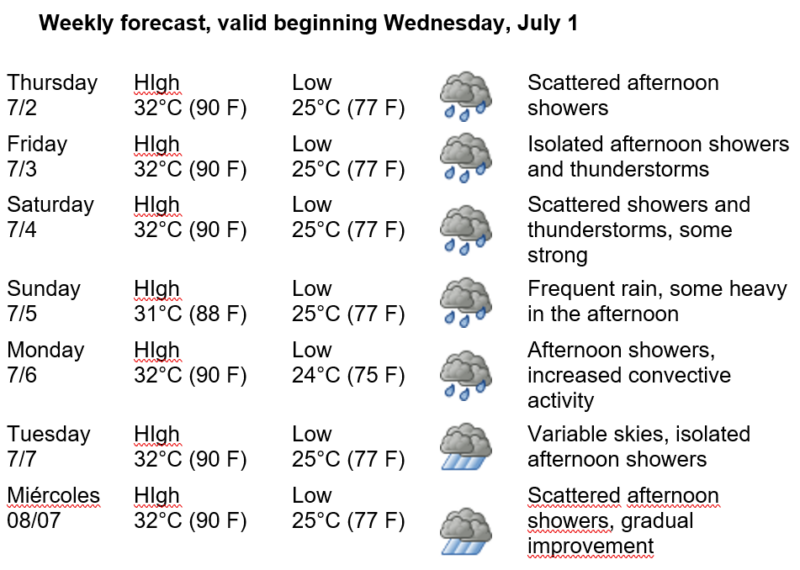
The typical summer daytime convective pattern will persist throughout the forecast period, with mostly clear or partly cloudy mornings followed by cloud development and rainfall beginning around midday. Thursday, July 2, and Friday, July 3, will bring scattered afternoon showers and thunderstorms, with the highest probability over inland areas. The weekend—Saturday, July 4, and Sunday, July 5—will see increased instability, bringing more frequent and heavier rainfall, with some strong thunderstorms during the afternoon and evening. On Monday, July 6, afternoon convective activity will continue with scattered showers, while on Tuesday, July 7, instability will decrease slightly, with isolated showers lingering into Wednesday, July 8, when gradual improvement is expected during the afternoon, especially along Havana’s coastal and inland areas.
Winds will be predominantly from the northeast and east at speeds of 15 to 38 km/h (9 to 24 mph), with occasional gusts of up to 50 km/h (31 mph) during thunderstorms. Relative humidity will remain high, with minimum values near 65% and maximum values approaching 95%. High temperatures will range between 31 and 32°C (88 to 90°F), while lows will range from 24 to 25°C (75 to 77°F). Sea surface temperatures will remain near 29°C (84°F).
Across the Atlantic Ocean, Caribbean Sea, and Gulf of Mexico, no tropical cyclone development is expected that would pose a threat to Cuba during the next seven days. Nevertheless, Cuba’s Institute of Meteorology (Insmet) is maintaining its routine seasonal monitoring, as the western provinces, together with the Isle of Youth, remain the areas of greatest climatological exposure during the month of July, according to the 2026 seasonal forecast.