
Nicaraguan Health Ministry Conceals Chikungunya Outbreak
The 758 cases recorded during the first two weeks of August account for more than half of the 1,384 registered in the country since May 23, 2026.
HAVANA TIMES – “Unspecified virus.” That was the diagnosis recorded on the medical leave form a doctor gave to Karla, who arrived at a Managua hospital with fever and body aches. This is how the Ministry of Health (Minsa) is recording cases in order to conceal the chikungunya outbreak in the country, where authorities have officially registered more than 1,300 cases in just 12 weeks.
“They know, but they’re forced to say it’s something else,” explains Karla, who was prescribed acetaminophen and underwent blood tests. Minsa never confirmed that she had chikungunya.
Hospitals are full of people arriving with high fever, severe body aches, and other symptoms consistent with chikungunya, but Minsa has orders not to register them as such.
Karla sought medical attention on the first day she developed a fever. The doctor explained that the tests were intended to determine her platelet levels and that, because the illness had only just begun, the results did not show “much variation.” He told her to return a few days later and that she could come back before her next appointment to “repeat the tests” if she developed warning signs such as “bleeding gums or vomiting.”
“I felt like I was dying, with a fever and horrible body aches (…) I went to have the blood test done, and they told me I was already out of danger. That was all the medical attention I received,” Karla confirms. They never told her she had tested positive for chikungunya.
Karla will never know for certain whether the test results confirmed that she had chikungunya. The most common symptom of the disease is the sudden onset of fever accompanied by joint pain. “It was chikungunya, but they disguise it as something else,” she insists.
Doctors Change Diagnoses
Her son also became ill, but in his case, during the first consultation the doctor told her that his “symptoms were consistent with chikungunya.” Minsa, however, later treated the situation as a case of a “viral infection.”
The doctor who treated the boy explained to Karla that 80% of the cases that had come in that day involved clinical symptoms associated with chikungunya, dengue, or malaria. “That was the only day they were explicit about what it was,” she says.
While they were in the doctor’s office, she recalls, the physician stepped out to report the case — she does not know “to whom” — and when he returned, he told her that her son’s symptoms “fell within the viral cases they had been receiving.” “The whole time they said it was a viral infection, but without saying which virus it was,” emphasizes the mother, who recovered along with her son.
During the COVID-19 pandemic, Minsa classified cases as “unspecified” or “undetermined,” a practice that CONFIDENCIAL documented as part of the opaque handling of official statistics. Sources connected to Minsa said at the time that this was the “order,” while specialists noted that an inconclusive test should be repeated.
Chikungunya Outbreak in the Country
Minsa did not record any cases of chikungunya during the first months of the year, but since late May the disease has spread rapidly in Nicaragua. Press releases issued by Minsa through the regime’s propaganda outlets show that between May 23 and August 8, 2026, a total of 1,384 cases were recorded, of which 758 — more than half the total — were reported during the final two weeks of that period.
The first 24 infections were reported between May 23 and 30. From then on, the curve continued to rise: the week ending August 1 saw the highest number, with 402 cases, followed by the week ending August 8, with 356.
Undercounting of Cases in the Country
“It wasn’t COVID. It was chikungunya.” That was the conclusion reached by one family after one of its members became ill and developed, among other symptoms, fever, joint pain, and “red spots” on her skin. “My sister had a rash, but it’s gone now,” says Marcos.
At around the same time, Marcos developed flu-like symptoms, fever, and a headache. “I spent a week with a fever and a headache,” he recalls. He also had difficulty eating. “It wasn’t that I didn’t feel like eating; I simply couldn’t get food down because my throat felt closed up,” he explains.
Neither of them went to a health clinic for medical attention. They concluded that it was chikungunya based solely on their symptoms. “I’m healthy now, but we’re taking precautions to keep my mother from getting sick,” Marcos said.
Minsa’s Measures Are Insufficient
Chikungunya is transmitted by the Aedes aegypti mosquito and typically causes fever and severe joint pain. Symptoms generally begin four to eight days after a mosquito bite but can appear at any time between the second and twelfth day, according to the Pan American Health Organization.
In an interview with one of the government-controlled media outlets, Deputy Health Minister Carlos Saenz acknowledged, in reference to dengue, that “the number of cases has increased dramatically, and the same is true of chikungunya. There are many countries that are also reporting cases of chikungunya, which is transmitted by the same mosquito,” the official said.
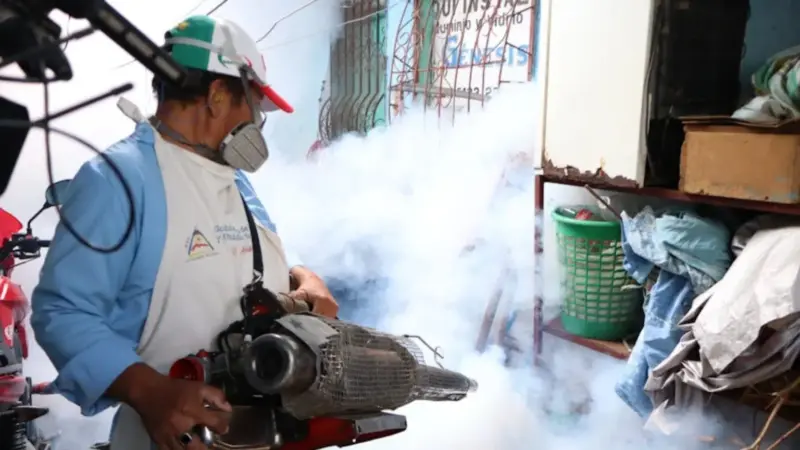
Although Minsa continues its fumigation campaigns in different parts of the country, the measure has so far failed to halt the steady increase in infections reflected in its own weekly reports.
On August 3, 2026, the US Center for Disease Control and Prevention included Nicaragua — specifically Managua — among areas experiencing chikungunya outbreaks. It classified the country at Level 2 on its four-level Travel Health Notice scale. The US CDC issues these notices to alert travelers to health risks around the world, whether from disease outbreaks, mass gatherings, or natural disasters. Through these notices, the agency also recommends protective measures travelers can take to avoid infection.