
Where Is Cuban Artist Luis Manuel Otero Being Held?
His five-year prison sentence ends on July 9th
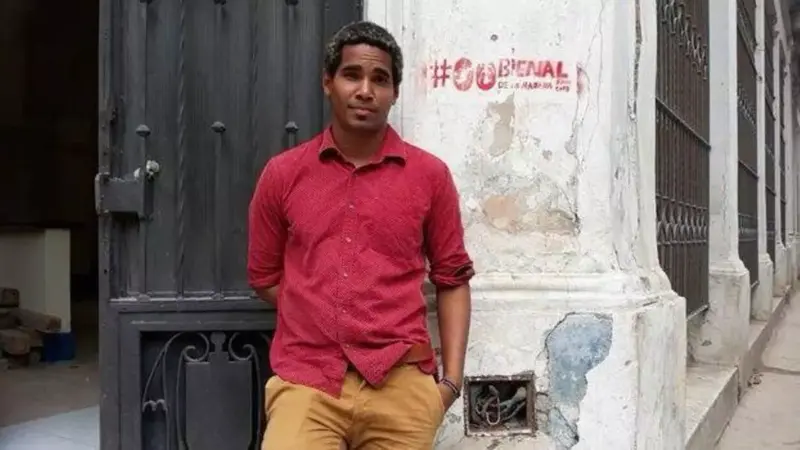
According to Cuban art historian and activist Yanelis Nuñez, it is unknown whether a forced exile is about to take place.
HAVANA TIMES – Cuban visual and performance artist Luis Manuel Otero Alcántara was reportedly released Tuesday from the maximum-security prison in Guanajay, Artemisa province, according to his official channels. However, the whereabouts of the political prisoner are unknown to family, friends and supporters. He has spent the last five years in prison for his artistic expression and activism unfavorable to the Cuban government.
The exact date of his transfer is unknown with precision, but he has not been at that prison since at least July 7th, and as of early Wednesday morning his whereabouts remain unknown. His family has confirmed that the leader of the San Isidro Movement is not at his usual residence in the El Cerro neighborhood of Havana.
Activist and art historian Yanelis Núñez confirmed this Tuesday to the independent newspaper 14ymedio that Otero’s prison release date was July 9, just as recorded in the document delivered by the Supreme Court regarding the artist’s case and the fulfillment of his sentence.
“Today we learned from other prisoners that Luis has been taken from prison. At this time, we don’t know where he is. We have spoken with his family in Cuba, and he is not at home. We are waiting for more information to find out where he is,” said Núñez, who lives in Madrid.
“The regime has put on the table the option of exile for Luis Manuel in recent months, but we have no certainty that this will happen in the coming hours or days. It’s something that is on the table, due to pressure from the regime itself,” the activist added.
The artist’s official platforms assured that they will continue to provide urgent updates as soon as any verified information about his status and location is confirmed. Around noon, Madrid time, Núñez posted on social media: “A parole request for Luis Manuel was initiated in the United States a few weeks ago, which, if approved, will grant him a way to leave the country. The Castro regime’s decision, in response to the delay, has been to detain Luis because they don’t want him on the street for even a few days or hours, much less so close to July 11th, [the five year anniversary of the massive protests.”]
The activist added that “the Cuban dictatorship is not giving in. It is not opening up. Luis should already be free; in fact, he always should have been. The Cuban dictatorship is repressing people more and more each day, and it will continue to do so until we remove them from power.” She also stated that the regime is repeating a repressive pattern “that dictates that the only paths for an activist are silence, imprisonment, or exile.”
Otero Alcántara had been in prison since July 2021 after attempting to participate in the July 11 protests. He was sentenced in 2022, along with rapper Maykel Castillo ‘Osorbo’, to five and nine years, respectively, for the crimes of “contempt” and “public disorder,” commonly used to punish political expression contrary to the government on the island.
Since 2022, the Penal Code has incorporated the concept of “propaganda against the constitutional order,” used to imprison citizens who express themselves in ways as diverse as putting up anti-government posters or publishing their critical opinions on social media.
During his time in prison, the artist staged several hunger strikes and was recognized as a prisoner of conscience by Amnesty International, while international organizations such as Human Rights Watch (HRW) and PEN International demanded his immediate release.
This Tuesday, Cuban Foreign Minister Bruno Rodríguez Parrilla engaged in a heated exchange of accusations with United States ambassador to the UN, Mike Waltz, regarding the issue of political prisoners, during the intense debate of the General Assembly on the US embargo against the Island.
Waltz said that “the regime and its representatives do not want you to hear the following: that this month marks anniversary of when thousands of Cubans took to the streets to demand their freedom.”
“For 67 years, the regime has enriched itself by abusing its people, stifling private enterprise, and penalizing dissent with a communist economy,” the ambassador added.
Waltz then exhibited a series of photographs of some artists detained by the Cuban government, including Luis Manuel Otero Alcántara.
“Look at their faces when they give their speeches, because they are in jail for demanding freedom. They are not violent; what they do is write poetry and songs, and that is why the regime is trying to eliminate them by putting them in jail,” the ambassador emphasized, addressing the UN member states.
Translated by Regina Anavy for Translating Cuba.