
Raulito’s Interview: Not Just a Message to Washington
Raul Castro’s grandson’s words also bode a signal from Havana
HAVANA TIMES – Cuba stands at a historic crossroads. A deepening economic crisis, a mass exodus of its people, and mounting internal and external pressures have forced a reckoning: the island can no longer afford indefinite delay. The real choice is no longer simply between preserving the past and embracing change. It is between managed transformation and uncontrolled collapse.
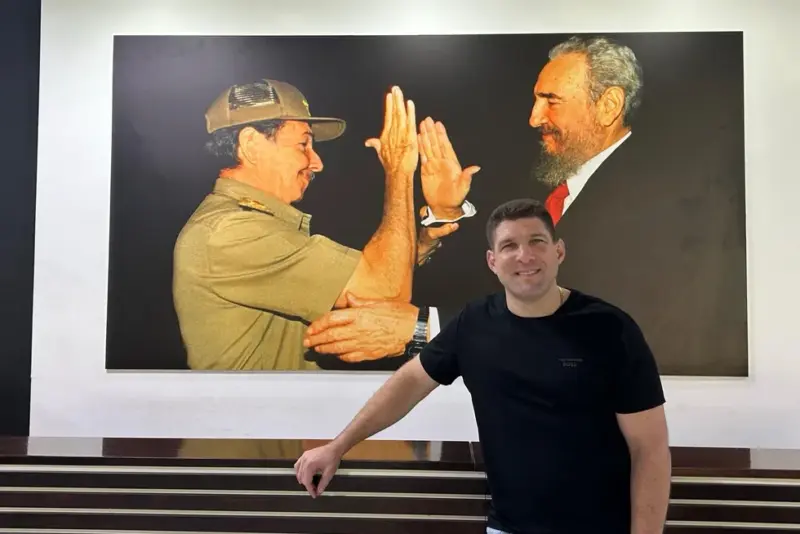
Against this backdrop, Raul Guillermo RodrIguez Castro—known as “Raulito” (Little Raul), grandson of former Cuban leader Raul Castro—gave his first interview to a major US media outlet. In an exclusive conversation with USA Today, he stated that he is prepared to engage with whoever the US administration designates, including the possibility of direct discussions with President Donald Trump.
“I can negotiate with anyone designated by the US. If given the opportunity, claro que con Trump (of course with Trump),” he said.
Naturally, headlines focused on his openness to dialogue with Washington. But the deeper significance of the interview may lie elsewhere.
It was not primarily a message to Washington.
It was a signal to Havana!
A Message to the Cuban Establishment
At first glance, Raulito’s remarks appear to represent a diplomatic overture: a willingness to explore dialogue with the United States while reaffirming loyalty to the principles of the 1959 Revolution and Cuba’s sovereignty.
Yet Raulito currently holds no formal government or Communist Party position authorizing him to negotiate on behalf of the Cuban state. His influence derives from his family ties, his proximity to the revolutionary leadership, and informal networks of trust within the Cuban establishment.
In Cuba’s highly centralized political system, a high-profile interview addressing sensitive issues such as relations with the United States would likely receive close attention from influential circles in Havana.
This suggests that the interview’s most important audience was not only Washington.
It was the Cuban political elite, the Communist Party, and the Cuban public.
The message appears carefully calibrated: a new figure is being introduced, his ideas are being tested, and his potential role in the country’s future is being quietly explored.
The Language of Duty
One sentence from the interview deserves particular attention:
“But if at some point the revolution needs me to step up, I will do it.”
This is not the language of personal ambition. It is the traditional language of revolutionary politics: duty, loyalty, and service to a historic mission.
Raulito did not present himself as someone seeking power. Instead, he portrayed himself as someone prepared to serve if called upon.
That distinction matters.
As the revolutionary generation gradually disappears from the political stage, Cuba faces a fundamental challenge of legitimacy. Authority based solely on the historical credentials of 1959 cannot sustain itself indefinitely. The next generation must increasingly justify its role through competence, economic performance, and the ability to address the daily struggles of ordinary Cubans.
The Castro last name provides Raulito with extraordinary visibility, but it also creates a dilemma. The same legacy that opens doors may also raise questions about whether he represents genuine renewal or continuity under a new generation.
From Revolutionary Legitimacy to Post-Revolutionary Governance
The deeper issue is not Raulito’s personal future. It is whether Cuba can transition from revolutionary legitimacy to effective post-revolutionary governance.
For decades, the Cuban state has drawn strength from its founding narrative. But history alone cannot govern a modern society. Today’s challenges demand new answers:
• Can Cuba generate genuine prosperity while safeguarding sovereignty?
• Can it pursue economic opening without sacrificing stability?
• Can it reform institutions to meet the aspirations of younger generations?
• Can it avoid stagnation without inviting chaos?
Raulito’s emergence—combining loyalty to the Revolution with a willingness to engage Washington—may represent an attempt by parts of the Cuban establishment to manage generational renewal rather than risk abrupt rupture.
Whether he eventually assumes an official role in government, the Party, diplomacy, or remains an influential informal figure remains uncertain. Much will depend on his ability to demonstrate leadership beyond his family name.
For months, I have argued that Cuba’s future depends less on choosing between socialism and capitalism, or between Washington and Beijing, than on choosing between renewal and stagnation.
Raulito’s interview does not provide the answer.
But it offers an important clue.
The most consequential message was not the one sent toward the United States. It was the one directed at Havana.
It suggests that Cuba’s leadership may be preparing for a new chapter, one in which the survival of the Revolution depends not only on defending its past, but on creating a viable future.
Whether this path leads to genuine transformation or merely the repackaging of old power under a new face remains Cuba’s central unresolved question.
*Khanh Vu Duc is a professor at the, University of Ottawa, Canada, Faculty of Law
China of the Caribbean is being built.
The name cannot and must not be allowed to function as idea or cure to the grave problems that cuba faces, a new and invigorating leader must emerge , and if needed a democratic socialist, but; definitely not with the previous namesake that destroyed a country that had a GDP that was comparable to some small european countries and one of the best in latin america, what cuba needs is a leader who has vision and most of all who cares about Cuba and its people, when this person emerges the country must stand with him or her to defend cuba.
The Lepard cannot change his spots