
The Charcoal Makers of Soplillar
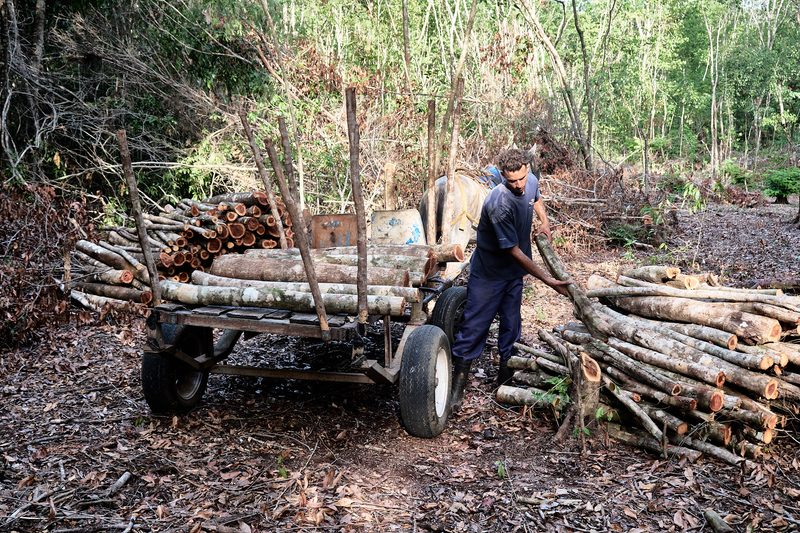
HAVANA TIMES – In Soplillar, a small village of fewer than 300 inhabitants tucked away in the Zapata Swamp, south of Matanzas, the day begins and ends amid the woods, water, and smoke.
The community is located in one of Cuba’s most important natural areas: the Zapata Swamp, the largest wetland in the Caribbean. There, where roads mingle with canals and the woods begin practically behind people’s homes, residents have learned over generations to make use of what their surroundings provide.
One of those activities is the production of charcoal.
Charcoal has been part of Soplillar’s history since long before 1959. But in recent years it has taken on renewed importance. The prolonged energy crisis and fuel shortages have made charcoal an increasingly sought-after and, therefore, more expensive product. In many parts of Cuba today, cooking depends on finding some alternative source of fuel.
For 23-year-old Juan Gabriel, making charcoal is a trade he learned, rather than inherited.
He learned it during his military service. His performance in this work was even rewarded with an unusual incentive: he was allowed to finish his required period of service early. When he returned to Soplillar, he continued doing what he had learned. About five years have passed since then.
Today, Juan Gabriel knows the trade with the precision of someone who has repeated the same movements many times. He selects and cuts the trees, transports the logs, piles them up, and begins building the kiln.
The charcoal-making site is located on a cleared piece of land. The area must provide enough room to work with the wood and later cover it completely. The logs are arranged in a circular structure that gradually takes the shape of a large cone.
Then comes one of the most delicate parts: covering it.
First, grass is laid over the wood, followed by a thick layer of earth. The goal is to prevent oxygen from getting inside. The wood must not burn completely; it must be slowly exposed to heat until it turns into charcoal. That is why a kiln cannot be left unattended.
It must be watched for hours, during the day and especially at night. A small hole in the covering can allow oxygen to enter and cause the wood to burn completely. A moment of carelessness can mean losing all the work.
Juan Gabriel has learned to recognize the kiln’s signals and correct any problems. Even so, each batch requires physical effort and constant vigilance. His most recent batch produced around 80 sacks of charcoal. Each can be sold locally for about 1,000 Cuban pesos.
The income he has earned in recent years has allowed him to achieve something that is difficult for many young people in rural areas: independence. Juan Gabriel no longer lives with his parents. He was able to buy a home and make some improvements to it.
Gabino works alongside him.
Gabino also knows the secrets of charcoal making, but his work does not end there. In Soplillar, he does practically any job that comes along. One of his main activities is selling fish. He buys it directly from fishermen and then resells it in the community and surrounding areas.
Because in Soplillar, the woods are not the only source of livelihood.
Water is equally present in everyday life.
Small boats are a common sight in the canals that cross the swamp or in the areas leading out to sea. Some use motors; others still depend on oars. Fishing takes place both in the canals and in the open sea. A boat may appear in the middle of the landscape as a natural extension of the surroundings.
Agriculture is also part of community life. Families grow crops primarily for their own consumption, although some of the surplus can be sold in nearby towns.
In recent years, some families in the area have participated in international cooperation projects. Through these projects, they have received equipment intended to make agricultural work easier: a planter, a tractor, and several electric tricycles, among other resources. But receiving a machine does not necessarily mean being able to keep it running.
The projects that provided some of this equipment did not always take into account the subsequent maintenance costs. When breakdowns occur, replacement parts are difficult to obtain. Added to this is the shortage and high cost of fuel. As a result, machines intended to make work easier end up deteriorating without ever being fully utilized.
The same difficulty affects fishing. Keeping a motor running requires fuel, and fuel is scarce. That is why oars remain an indispensable tool for some fishermen.
Life in Soplillar, however, unfolds with a tranquility that contrasts with these difficulties.
It is a small village where practically everyone knows one another. Relationships among neighbors retain a familiarity that is difficult to find in larger communities. The houses, roads, charcoal-making sites, crops, and canals are all part of the same everyday landscape.
[ngg src=”galleries” ids=”2250″ display=”horizontal_filmstrip”]
Thanks for this wonderful account of the diversity and resilience of Cuban’s outside of the larger communities and cities. I really appreciated expanding my knowledge of the Cuban people.
My fondest memories of Cuba are in Soplillar. My yearly trips always included a birding trip to this area. My birding guide was also a charcoal maker and on my first trip he took me to his farm and showed me how he made charcoal. I learned so much from him and cherish every photo I have from spending time with him. In addition to making charcoal, he raised a few pigs and farmed vegetables. It was not an easy life for him or his wife and children. To me they were the havenot backbone of Cuban society, far removed from the car driving elites of Habana. I learned more from him than anyone else I encountered in Cuba. By the way, the boat photos in the article are from Playa Larga, not Soplillar